

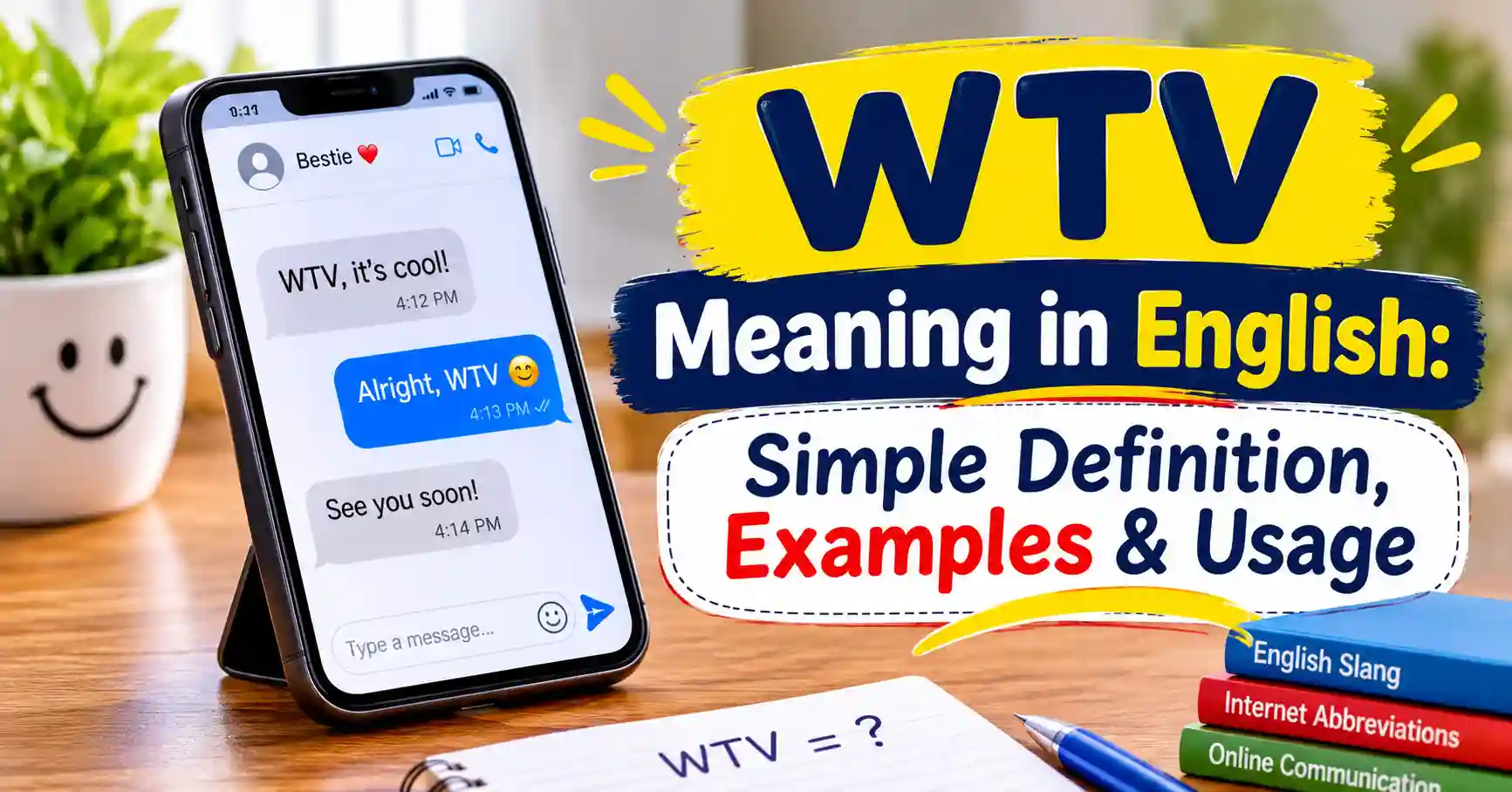
You ask your friend where to eat. The reply comes back in seconds: “wtv.” That is all. No emoji, no punctuation, no hint of a mood. Does it mean “I am happy with anything”? Or does it mean “I am tired of this conversation”?
Three letters should not cause that much worry. Yet they do, because the same shortcut can sound relaxed in one chat and cold in another. The words did not change. The situation did.
This guide explains the wtv meaning in plain words and gives you the full picture. You will learn what the term stands for, where it comes from, and how to read its tone. You will see how to use it without sounding rude. Every part uses short sentences and simple words, so you can skim, find what you need, and move on.
Quick answer: WTV is text shorthand for “whatever.” People use it to say “I do not mind,” “it does not matter,” or sometimes “I am done with this.” Tone decides which one.
Read More: Huzz Meaning Explained: Slang Definition, Usage & Examples in Gen Z Texting
What Is WTV? A Simple Explanation
What does WTV stand for? It stands for “whatever.” The writer drops the vowels and keeps the main consonants: W, T, V. That is the whole trick. Texters have shortened words this way for years, and WTV follows the same pattern.
The word “whatever” has several jobs in English. WTV can do all of them. Here are the main ones.
- Any choice is fine. “Pick a movie. WTV works for me.”
- I do not have a strong opinion. “WTV you decide.”
- It does not matter. “WTV, it is only a small thing.”
- I disagree, and I am done talking. “Okay. WTV.”
- And so on. “We can grab tacos or WTV.”
The first three jobs are friendly or neutral. The fourth job sounds sharp. The fifth job is vague on purpose. Because one word covers so many feelings, readers must look at the context to decide which one the writer means.
Why do people type it instead of the full word? Speed is the main reason. “Whatever” has eight letters. WTV has three. In a fast chat, that saves time. Style also matters. Short replies feel casual and relaxed. Typing a long word can feel too formal for a quick message to a friend.
You will mostly see WTV in texts, group chats, direct messages, and social media comments. You will rarely see it in books, news stories, or official emails. It lives in casual spaces where people write the way they talk.
The Four Moods of WTV
The same three letters can carry very different feelings. Learning the four common moods helps you read a message correctly.
Mood 1: Easygoing. The writer has no preference and wants to keep things simple. “WTV you want for dinner.” This is the friendliest use. It says, “I trust your choice.” People often add a smiley, a laughing face, or an exclamation mark to make the warmth clear.
Mood 2: Indifferent. The writer does not care about the topic. “WTV, I do not follow that show.” This is neutral. It is neither warm nor cold. It simply states that the subject does not matter to them.
Mood 3: Dismissive. The writer wants to end the talk. “I already explained it twice. WTV.” This version often has a period, a short sentence, or no other words. It signals frustration. Readers usually feel the chill right away.
Mood 4: Vague wrap-up. The writer trails off to avoid listing every detail. “We need snacks, drinks, or WTV.” In this case, WTV means “and similar things.” It does not carry any attitude at all.
Reading the WTV meaning in a real message takes clues. How do you tell the moods apart? Look closely. Check who sent it. A close friend usually means the easygoing mood. A person you just argued with may mean the dismissive one. Check what came before. A question about plans points to the easygoing mood. A heated disagreement points to the dismissive one. Check the punctuation and emoji next. A lone “wtv.” with a period feels colder than “wtv!! 😂.”
When you cannot tell, ask. A quick “Are you okay with that, or do you want to talk about it?” clears the air. The question shows care, and it lets the other person explain.
Explore More Meaning: What Does SYBAU Mean Stand For? Meaning in Gen Z Slang
Where WTV Comes From
The word “whatever” is old and ordinary English. People use it in speech all the time. The shortened form came later, with digital writing.
Early text messages had tight limits on length. Chat apps rewarded fast replies. Writers learned to cut vowels and shrink common words. You see the same habit in “pls” for “please,” “txt” for “text,” and “msg” for “message.” WTV fits the same pattern. It removes the vowels and leaves a short, quick shape that readers still recognize.
No one can name the first person who typed it. No dictionary or study clearly records a first use. Be careful with websites that claim a precise date or inventor. They usually guess. What we can say is simple. The shortcut grew from everyday texting habits, and it spread because it saves time and sounds casual.
You will also see other spellings. People write “whatev,” “wtvr,” “watever,” and “wateva.” They all mean the same thing. Some look more playful. Others look more careless. The shortest one, WTV, is the most common because it is the easiest to type.
Why has it lasted? The idea behind it never goes out of style. People often need a quick way to say, “Either choice is fine,” or “I will let this go.” English has few short, casual phrases for that job. “Whatever” fills the gap, and WTV makes it even faster.
It also helps to remember that slang changes. A term can feel fresh one year and old the next. The WTV meaning has stayed steady because it is just a shortened everyday word, not a joke or a trend. That makes it more stable than slang built on a single meme.
How to Use WTV in a Sentence
Using WTV is simple. It usually sits in one of four places.
As a one-word reply. “WTV.” This is the fastest form. It also carries the most risk, because the reader gets no extra clues. Use it only with people who know your style.
At the start of a sentence. “WTV, I am fine with either option.” The comma after it helps. It separates the shortcut from the rest of the sentence.
At the end of a sentence. “You can pick the place, WTV.” This version often feels relaxed and casual.
As a vague wrap-up. “We can watch a movie or WTV.” Here it means “or something like that.” It has no attitude.
Capital letters are flexible. “WTV” looks sharper. “wtv” looks softer and more casual. Neither one is wrong. Many people use lowercase for friendly chats.
Add warmth when you want to avoid confusion. A smile, a laughing face, or a short follow-up helps. Compare these two lines:
- “wtv.”
- “wtv, I am happy with anything 🙂”
The second line removes all doubt. The first one leaves the reader guessing.
What does WTV stand for if you see it in a hurry? Just think “whatever.” Then check the mood by looking at the clues around it. If you still feel unsure, spell it out the first time. After that, use the short form.
Keep one more rule in mind. Use WTV for low-stakes choices. Pizza or tacos? Fine. Which medicine to take, or whether to sign a contract? Not fine. Big decisions deserve clear words, not a shrug.
Meaning Tips You May Like: ESL Meaning for Beginners: Simple Definition, Examples & Usage
Is WTV Rude? Reading the Tone
The short answer: it can be. The shortcut itself is neutral, but “whatever” has a long history of sounding dismissive in speech. Many people can recall a time when someone said it with an eye roll. That memory carries over to the text version.
Four factors decide whether WTV sounds rude.
The relationship. Close friends joke and tease. A WTV from a best friend feels light. The same WTV from a boss or a stranger feels cold.
The topic. A reply about lunch is low stakes. A reply about a serious problem feels dismissive. Saying WTV to someone who just shared bad news will hurt.
The punctuation. A period after it feels firm. “Wtv.” can sound like a closed door. Exclamation marks, emoji, or extra words soften it.
The timing. A quick WTV in a fun chat feels playful. A WTV after a long silence or after a disagreement feels sharp.
What should you do if a WTV stings? Do not guess the worst. Ask a calm question, such as, “Did I upset you?” If it came from someone you trust, they will likely say it was not meant that way. If it keeps happening, you can say how it feels: “When you reply with wtv, I feel brushed off.” That sentence is honest and clear.
What if you are the sender? Think before you type it. If you want to share a view later, say so. “I am not sure yet; can we talk after?” is kinder than a cold reply. The goal is to protect the relationship, not to win the moment.
The wtv meaning never changes, but its feeling does. Your job is to read the situation, not just the letters.
Keep Exploring: IEP Meaning in Special Education: Definition, Examples & Usage
WTV in Work and Formal Settings
Work chats vary a lot. Some teams joke in short bursts. Others expect polished writing. WTV belongs in the first group, and even there only with care.
Where it can work. In a relaxed team chat between close coworkers, WTV may pass for a casual “either way is fine.” For example, a teammate asks whether to meet at ten or eleven. You reply, “WTV works for me.” The context is simple and friendly.
Where it fails. In emails to clients, messages to managers, job applications, or customer service replies, WTV looks careless. It can also sound like you do not care. A client who reads “WTV” in response to a question may think you are ignoring their concern.
With global readers. Not everyone knows English slang. A colleague who learned English at school may not recognize the shortcut. A translation tool may turn it into nonsense. Write the full word when your audience is mixed.
Better choices for work. Try these polite options.
- “I am flexible. Either option works.”
- “I have no strong preference.”
- “Happy to go with the group’s choice.”
- “Both choices are fine with me.”
Each one says the same thing as WTV. Each one sounds respectful. The extra few words cost almost nothing, and they protect your image.
A simple test helps. Would you say the word “whatever” out loud in the same setting? If you would hesitate, do not type WTV. If you would say it with a smile to a friend, the casual form is likely fine. Even a harmless wtv meaning still needs the right setting.
Real-World Examples of WTV in Action
The scenes below are illustrative. They are made-up situations that show how people use the term. Each includes a quick note on tone.
Example 1: The dinner plan. Friend A: “Italian or Thai tonight?” Friend B: “wtv, you pick 😄.” The emoji and the trust make this easygoing. Tone: friendly.
Example 2: The movie night. A group chat debates a film. One person writes, “I have seen all of them, wtv is fine.” This signals flexibility without drama. Tone: relaxed.
Example 3: The cold reply. Two roommates argue about dishes. One writes a long message. The other replies, “wtv.” The reader feels brushed off. Tone: dismissive.
Example 4: The gentle shrug. A student asks a friend whether to wear a blue or green shirt to a party. The friend writes, “wtv, both look good!” The compliment makes the shrug warm. Tone: supportive.
Example 5: The vague list. A teammate writes, “Bring snacks, drinks, or wtv you like.” Here the word works as “anything similar.” Tone: neutral.
Example 6: The parent and teen. A teen asks for a later curfew. The parent explains the reasons. The teen sends, “wtv.” The parent reads it as an eye roll. Tone: frustrated.
Example 7: The work chat. Two coworkers on a small team decide a meeting time. One writes, “wtv works, 10 or 11.” The message is clear and brief, and the relationship is close. Tone: casual and fine.
Example 8: The fandom debate. In a comment thread, one fan argues for ten minutes about a show. Another writes, “ok wtv 😂.” The laughing face turns it into a joke. Tone: playful.
Example 9: The apology that failed. Someone sends a long apology. The other person answers, “wtv, it is fine.” The words say “fine,” but the first word suggests the opposite. The mixed signals confuse the sender. Tone: mixed.
Notice the pattern. The same three letters carry warmth in some scenes and distance in others. Emoji, topic, and relationship change the effect. That is why its tone depends so heavily on context, even though the dictionary version is simple.
Learn More About: FWIW Meaning: Definition, Examples & Professional Usage
Common Mistakes and Misconceptions
A short word can still cause long trouble. Here are the mistakes people make most.
Mistake 1: Assuming it is always rude. Many uses are friendly. Treating every WTV as an insult can start fights that did not need to happen. The WTV meaning on its own carries no insult.
Mistake 2: Assuming it is always harmless. The reverse mistake is also common. A WTV after a serious message can hurt. Think before you send it.
Mistake 3: Using it for important choices. Big decisions need clear words. A reply such as “wtv” about a deadline or a safety issue sounds careless.
Mistake 4: Using it in formal writing. Emails, reports, cover letters, and school essays call for full words. Slang can weaken your message and your image.
Mistake 5: Mixing it up with other shortcuts. WTV is not the same as IDC (“I do not care”) or IDK (“I do not know”). Each one signals something different.
Mistake 6: Believing the made-up stories. Some websites claim exact dates or inventors for WTV. They do not have proof. Treat those claims with caution. The safe fact is that it is a short form of “whatever.”
Mistake 7: Ignoring the reader. Older relatives, new English learners, and formal contacts may not know the shortcut. A quick full spelling avoids confusion.
Mistake 8: Thinking spelling matters. “Wtv,” “WTV,” and “wtvr” all work in casual chats. Do not argue about capital letters. Focus on tone instead.
Mistake 9: Forgetting that tone travels. Text has no face or voice. A WTV that feels light to you can feel heavy to the reader. When the topic matters, add a few words.
Mistake 10: Assuming a hidden meaning. In rare cases, WTV can stand for something else, such as a name in a niche group. If the context gives a clear clue, follow it. If not, “whatever” is the safe answer.
WTV vs. IDC, IDK, and Other Quick Replies
Many quick replies sound alike but mean different things. The wtv meaning becomes clearer when you set it next to its neighbors.
WTV (whatever). It shows flexibility, indifference, or annoyance. Tone depends on context. It can sound friendly or cold.
IDC (I do not care). This one is blunt. It says outright that the writer does not care. It sounds harsher than WTV because it names the feeling directly. WTV can hide behind a friendly tone. IDC rarely can.
IDK (I do not know). This is about knowledge, not feeling. The writer lacks the answer. It is not rude. It simply states the gap.
K or kk. This is a very short “okay.” It can feel curt, especially as a single letter. Some readers see it as cold. Others see it as efficient.
“Fine.” This word often carries hidden annoyance when written alone. “Fine.” with a period can sound upset. WTV and “fine” share that risk.
“Sure.” This is friendly and agreeable. It says yes without any edge. It is safer than WTV when you want to sound warm.
“Up to you.” This phrase is polite and clear. It hands the choice to the other person. It works at home and at work.
“Either works.” This is a precise way to show flexibility. It leaves no room for a cold reading.
Here is a simple rule. If you want to show you are flexible, use “either works” or “up to you.” If you want to joke with a friend, WTV is fine.
FAQ: Quick Answers About WTV
What does WTV stand for?
WTV stands for “whatever.” It is text shorthand that removes the vowels from the word. People use it to show flexibility, indifference, or sometimes annoyance. It appears mostly in casual messages, not in formal writing. Tone depends on context, punctuation, and the relationship between the people chatting.
Is WTV rude?
Not always. Between friends, it often means “I am fine with anything.” After an argument or a serious message, it can sound dismissive. The wtv meaning stays the same, but the mood changes. Check the context and ask a calm question if you feel unsure.
Can I use WTV in a work email?
Usually no. Work emails call for clear, polite wording. WTV can look careless or even rude. Use phrases like “either option works for me” or “I have no strong preference.” In a casual chat with close coworkers, it may be acceptable.
What is the difference between WTV and IDC?
WTV means “whatever” and can sound friendly or cold. IDC means “I do not care” and sounds blunter. WTV can mask a mood behind a casual tone. IDC says outright that the writer does not care. Pick the one that fits your real message.
Where did WTV come from?
It grew out of texting habits, where writers cut vowels to type faster. No source clearly records who typed it first or when. It simply shortens an everyday English word. Be careful with sites that claim an exact date or inventor.
Does WTV have other meanings?
Rarely. In nearly every chat, social post, or message, it means “whatever.” A few niche groups may use it for a name or a private code. If the context offers a clear clue, follow it. Context almost always makes the meaning clear. Without one, assume “whatever.”
How should I respond if someone sends me WTV?
Read the context first. If the topic was a small choice, take it as “either works” and decide. If it feels cold, ask a calm question like, “Are you okay with that?” You can also share how the message made you feel. Stay kind and clear.
Conclusion
The wtv meaning is simple: it is a short way to type “whatever.” People use it to say they are flexible, they do not mind, or they want to move on. The tone depends on the situation, the relationship, and the punctuation.
Use it with friends, on small choices, and in casual chats. Skip it in formal writing, serious talks, and messages to people who may not know the shortcut. When you want to be clear, add a few extra words.
Short messages leave room for confusion. A little care fills the gap. Read the clues, ask when you are unsure, and choose kind words. That habit works better than any abbreviation.
