

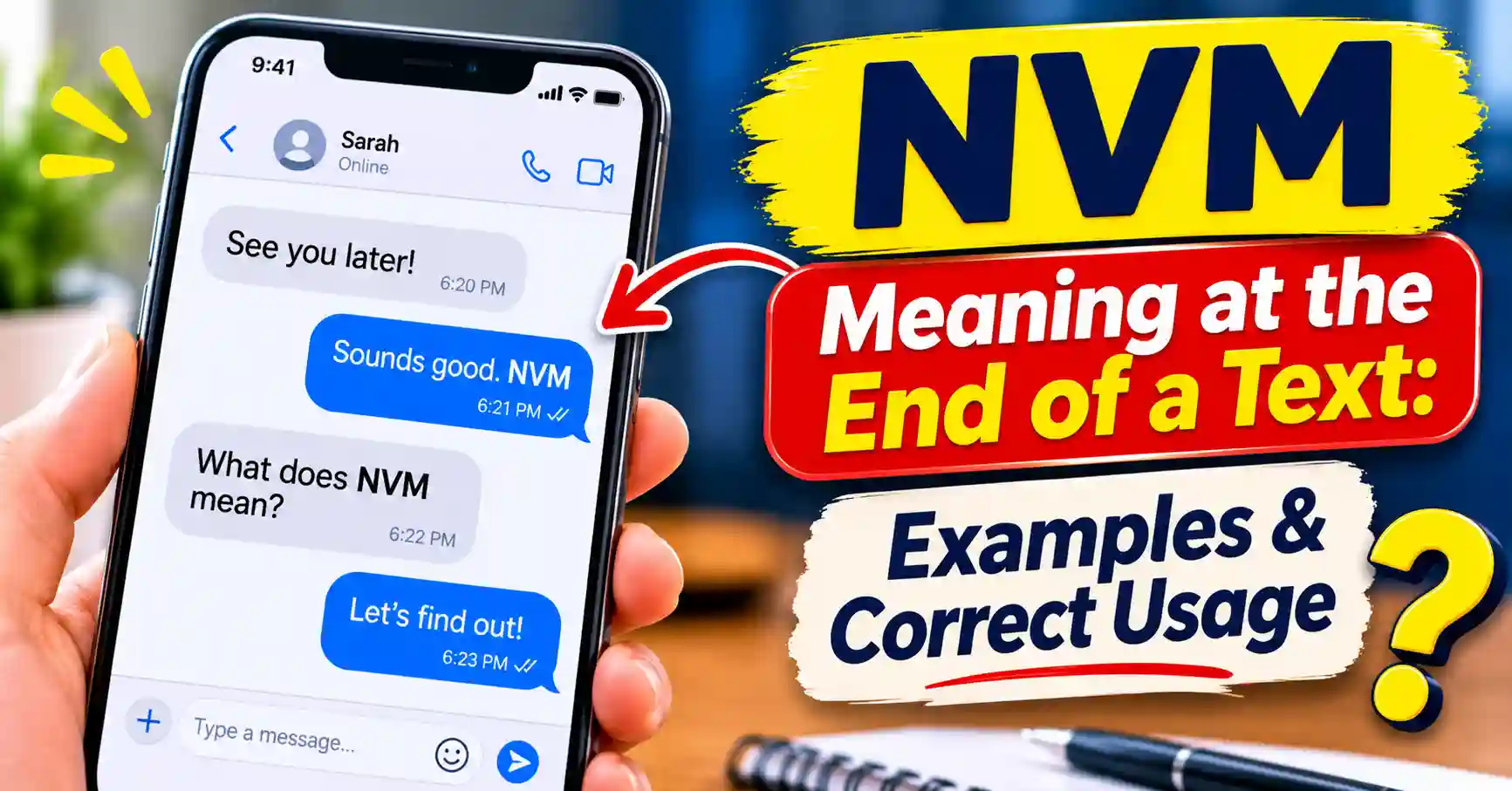
You send a text: “Can you pick me up at six?” Twenty seconds later, a second message appears: “nvm.” Your friend stares at the screen. Did you find a ride? Did you change your mind? Are you upset?
That tiny word does a lot of work. It cancels a request, closes a topic, and sometimes hides a mood. Most people use it every week without thinking about how it lands on the other side.
This guide explains the nvm meaning in plain words. You will learn what the letters stand for, why the word often appears at the end of a message, and how to read its tone. You will see how to use it without confusing people. Each part uses short sentences, so you can skim, find your answer, and get back to your chat.
Quick answer: NVM is text shorthand for “never mind.” People use it to cancel a question, drop a topic, or take back something they just said.
Read More: HB Meaning in Text: Usage, Origin & Real Examples Explained
What Is NVM? A Simple Explanation
What does NVM stand for? It stands for “never mind.” The writer keeps the consonants N, V, and M and drops the vowels. Texters have shortened words this way for years. You see the same habit in “pls” and “msg.”
Some people search with spaces between the letters. If you typed n v m meaning into a search bar, you landed in the right place. The spaced version and the joined version mean the same thing.
“Never mind” is a phrase with one main job. It tells the listener to forget what was just said. The speaker may have found the answer. They may have changed their mind. They may feel the topic no longer matters. NVM does that job in three letters.
You will see several versions of the word:
- nvm. This is the most common form. Lowercase looks casual and quick.
- NVM. Capitals look louder. Some readers hear them as firmer or more urgent.
- nvmd. The extra “d” stands for the last letter of “mind.”
- nm or n/m. These can also mean “never mind.” They can confuse readers, because NM can also mean “not much.”
Why do people type it? Speed is the first reason. “Never mind” has nine letters, and NVM has three. Habit is the second reason. Texting rewards short replies, and people want to match the pace of a chat. The third reason is softness. Typing “nvm” feels lighter than typing a long correction. It lets you step back without making a big moment out of it.
You will mostly find NVM in texts, group chats, direct messages, and social media replies. It rarely appears in formal writing. It belongs in casual spaces where people type the way they talk.
What NVM Means at the End of a Text
Where the word appears changes how it reads. Most people place it at the end of a message, after the point they want to cancel. That position carries a clear signal: “Forget what I just wrote.”
Look at this message: “Can you bring the charger? nvm, found it.” The sender asks a question. Then they cancel it before the other person can answer. The final word works like an eraser.
NVM at the end of a sentence. This is the most common pattern. The sender reconsiders in the middle of the message and backs out. “I think I will skip the party, nvm, I will go.” The change of mind happens in front of the reader.
Explore More Meaning: WTV Meaning in English: Simple Definition, Examples & Usage
NVM as its own follow-up text. The sender hits send, then thinks twice. A second message says only “nvm.” This can feel abrupt. The reader may wonder what changed and why. Adding a few words helps: “nvm, I figured it out!”
NVM after a question. “Do you know a good plumber? nvm, my neighbor just called one.” The ending saves the reader from doing extra work. It is a polite move, because it tells them they can stop thinking about it.
Why do people choose the end position? Because that is when the second thought arrives. Writers type as they think. The doubt shows up after the sentence, not before it. The end of the text becomes the natural spot for a quick U-turn.
The nvm meaning at the end of a message is a signal to check two things. First, check whether the request still stands. Second, check how the sender feels. Most of the time, the answer is simple. Sometimes it is not, and a short check-in helps.
Six Common Ways People Use NVM
NVM covers more than one situation. Here are the six most common.
1. Taking back a question. “Where is the meeting room? nvm, found it.” The writer solved the problem alone. This use is neutral and helpful.
2. Canceling a request. “Can you grab milk on your way? nvm, I will go later.” The sender releases the other person from the task. It saves time for both people.
3. Changing your mind. “Let us eat at six. nvm, seven works better.” The writer revises the plan in real time.
4. Dropping a topic. “Anyway, I was going to ask about last night, nvm.” The writer decides the subject is not worth it. Sometimes this is kind. Sometimes it hides a feeling.
5. Fixing a sending mistake. “Sorry, nvm, wrong chat.” The writer sent a message to the wrong person and cancels it. This one is common in busy group chats.
6. Signaling hurt or frustration. “Forget it, nvm.” This version carries a tone. The writer may feel ignored or annoyed. They pull back to avoid conflict. The message looks small, but the mood behind it is not.
The first five uses are practical. The sixth one is emotional. To tell them apart, read the whole thread. If the writer solved a problem, it is a practical use. If the writer felt dismissed first, it is likely an emotional one.
Knowing the nvm meaning is the easy part. A good habit helps both sides. If you send NVM, say why in a few words. If you receive it, think about whether it is a simple change or a quiet signal. A short, kind question costs little and can prevent a misunderstanding.
Where NVM Comes From
“Never mind” is an old English phrase. People say it all the time in speech. The abbreviation came later, with texting and chat.
Early mobile phones limited the length of messages. Typing on small keypads took effort. People shrank common words to save time and space. NVM grew out of that habit, and it stuck because it was easy to type and easy to read.
The exact first use of the abbreviation is unclear. No source clearly records who typed it first or when. Be careful with websites that claim a precise date or inventor. They usually guess. The safe fact is that it started in casual online and text writing and spread as more people used chat.
You will see a few related forms. “Nvmd” adds the last letter. “NM” and “n/m” are even shorter. The shorter forms carry more risk, because NM often means “not much” in answers to “what’s up?” That overlap can cause confusion.
Why has it lasted? Because the need never goes away. People change their minds. They solve problems on their own. They realize a topic does not matter. English has always needed a quick way to say that. The nvm meaning fits that need in a form that matches the speed of a chat.
Slang changes, but plain shortcuts of common phrases often stay. They do not depend on a trend, a joke, or a single video. They simply shorten something people already say. That is why NVM has lasted while many flashier slang terms faded.
Meaning Tips You May Like: What Does HY Mean in Text Messages? Real Examples & Replies
Is NVM Rude? Reading the Tone
By itself, NVM is neutral. It does not insult anyone. Still, the feeling behind it can vary a lot. Four clues help you read it.
The relationship. Close friends use it casually. A friend who says “nvm, found it” rarely means more than that. A coworker or relative may use it more carefully. Know the person before you read into it.
The timing. A fast NVM after a question usually means the writer solved the problem. A slow NVM after a long silence can mean the writer felt ignored. The wait itself carries the message.
The punctuation. “nvm!” sounds light. “Nvm.” with a period can sound closed and cold.
The history. Check the messages before it. If the writer asked for help and got no reply, then “nvm” likely means “never mind, you did not answer.” If the writer solved the issue, it likely means they are done.
What should you do if an NVM stings? Do not guess the worst. Ask a calm question: “Do you still need help with that?” or “Are you okay?” A short check-in shows care. If you tend to send NVM when you feel hurt, try saying so instead. “I was waiting for an answer and felt ignored” is clearer and kinder than a cold exit.
The nvm meaning never changes, but its mood does. The sender chooses the words, the reader supplies the feeling, and context fills the gap in between.
How to Use NVM Correctly
Using NVM well is simple.
Add a few words. “nvm, I figured it out” works better than “nvm.” The extra words tell the reader what happened. They remove the guessing.
Use it for small changes. A change in a dinner plan or a small question fits well. A serious topic does not. If the subject matters, write a full sentence.
Keep punctuation friendly. A comma or an exclamation mark softens it. A lone period can feel cold. An emoji can help in casual chats.
Pick one style. Lowercase feels relaxed. Capitals feel firm. Neither one is wrong, but stay consistent inside one message.
Spell it out for new readers. Older relatives, new English learners, and formal contacts may not know it. Write “never mind” the first time, then use the short form later if you need it.
Do not use it to hide a feeling. If you feel hurt, say so. A cold NVM can leave the other person confused and worried.
Match the setting. Texts to friends allow it. Emails to a boss or a client call for full words.
Many people who search n v m meaning also want to know how to use it well. A quick test helps. Read your message out loud before you send it. If it sounds fine when you say “never mind” to a friend, NVM works. If it sounds like a door slamming, add more words.
Remember that the word asks the reader to forget something. That is a big request in a small package. If the reader already started working on your question, a quick note of thanks is polite: “nvm, thanks anyway!”
Keep Exploring: ESL Meaning for Beginners: Simple Definition, Examples & Usage
NVM in Work and Formal Settings
Work chats vary. Some teams use short, casual replies. Others expect polished writing. NVM fits only in the first group, and only with people you know well.
Where it can work. In a relaxed team chat, “nvm, found the file” is clear and friendly. It saves everyone time. A short message keeps the thread clean.
Where it fails. In emails to clients, managers, or customers, NVM looks careless. It can also confuse readers who do not know slang. A client who reads “nvm” in response to a concern may think you are brushing them off.
With global teams. Not every reader knows the abbreviation. Translation tools may turn it into nonsense. Write the full phrase when your audience is mixed.
Better choices for work. Try these polite options.
- “Please disregard my last message.”
- “I found the answer, thank you.”
- “No need to follow up on this one.”
- “I have changed my mind. Here is my update.”
Each option says the same thing as NVM. Each one sounds clear and respectful. They also leave a record that is easy to understand later.
One more tip: in a busy channel, a retraction should name the item. “Please disregard my question about the budget file” is much clearer than “nvm.” Others may have missed the first message, and a vague note can confuse them.
Real-World Examples of NVM in Action
The scenes below are illustrative. They are made-up situations that show how people use the term. Each includes a short note on tone.
Example 1: The ride. “Can you pick me up at six? nvm, my sister can drive me.” The writer solves the problem before anyone answers. Tone: helpful.
Example 2: The lost keys. “Have you seen my keys? nvm, they were in my coat.” A quick cancel that saves the friend from searching. Tone: light.
Example 3: The wrong chat. “Can you send me the photos? Sorry, nvm, wrong group.” The sender notices the mistake and fixes it. Tone: apologetic.
Example 4: The changed plan. “Let us meet at five. nvm, I have a meeting. Six?” The sender revises the plan mid-message. Tone: practical.
Example 5: The hurt withdrawal. A friend asks for advice, waits hours with no reply, and sends “nvm.” The word signals disappointment. A kind reply is, “Sorry I missed this. I am here now.” Tone: hurt.
Example 6: The group chat joke. “Who is bringing snacks? nvm, I will bring everything and win the party.” The sender turns the retraction into a joke. Tone: playful.
Example 7: The work chat. “Does anyone know where the template is? nvm, found it in the shared folder.” A short update keeps the thread clean. Tone: professional enough for a casual team.
Notice the pattern. Some examples are practical. Others involve feelings. The same word works in both. That is why its tone always depends on the setting and the people.
Common Mistakes and Misconceptions
A short word can still cause long confusion. Here are the mistakes people make most.
Mistake 1: Sending NVM alone. A lone “nvm” leaves the reader hanging. Add a few words so they know what changed.
Mistake 2: Mixing it up with NM. NM can mean “not much,” as in “nm, you?” after “what’s up?” It can also mean “never mind.” Because of this overlap, NVM is the safer choice for the “never mind” meaning.
Mistake 3: Using it to hide hurt. If you feel ignored, say so. A cold NVM often makes the other person feel guilty without knowing why.
Mistake 4: Assuming it is always rude. Most uses are harmless. Treating every NVM as an insult can create fights that did not need to happen. The nvm meaning on its own carries no insult.
Mistake 5: Assuming it is always harmless. A late NVM after a serious message can signal real hurt. Read the situation.
Mistake 6: Using it in formal writing. Emails, reports, and schoolwork need full words. Slang can weaken your message.
Mistake 7: Spelling “nevermind” and “never mind” the same way. In careful writing, “never mind” as two words is the usual form when you tell someone to forget something. “Nevermind” as one word shows up in some casual uses. In texts, the abbreviation avoids the question entirely.
Mistake 8: Believing the wild stories. Some websites make dramatic claims about the abbreviation, with scary titles and fake secrets. Those claims are false. NVM is a plain short form of a common phrase.
NVM vs. NM, “Forget It,” and Other Ways to Say It
Many phrases do the same job as NVM. They differ in tone and clarity. The nvm meaning gets clearer when you compare it with the rest.
NVM (never mind). It cancels a message. It is casual and quick. Tone depends on context.
NM (never mind or not much). It can mean either one. Use it carefully. If someone answers “what’s up?” with NM, they usually mean “not much.” If they answer a question with NM, they may mean “never mind.”
NVMD. This is another short form of “never mind.” It is less common but clear. It avoids the NM confusion.
“Never mind” in full. This is the safest choice for formal or mixed audiences. It is polite and clear.
“Forget it.” This phrase can sound sharper. It often signals frustration. “Forget it, nvm” sounds much colder than “nvm, found it.”
“Disregard.” This word is formal. It fits work emails, such as “Please disregard my last message.” It sounds stiff in a friendly chat.
“Scratch that.” This phrase means “ignore what I just said.” It works for quick corrections in speech and text. It sounds relaxed and clear.
“My bad.” This admits a mistake. Use it with NVM when you sent something by accident: “my bad, nvm.”
“JK.” This means “just kidding.” It does not cancel a request. It says the earlier statement was a joke.
Which one should you pick? Use “scratch that” or NVM for quick fixes with friends. Use “never mind” or “please disregard” at work. A clear sentence beats a clever shortcut.
Other Meanings of NVM You May See
The same letters appear in tech, and the meaning changes completely. Context tells you which one fits.
Non-volatile memory. In computing, NVM stands for non-volatile memory. It is computer memory that keeps data even when the power turns off. Flash storage, such as the kind in many solid-state drives, is a common example. You may also see NVMe, which refers to NVM Express, a way to connect fast storage drives.
Node Version Manager. Developers use a tool called nvm to install and switch between versions of Node.js. It lets a programmer run different versions on one computer. You will see it in commands and setup guides.
How do you know which one applies? Look at the setting. A text from a friend points to “never mind.” A hardware page points to memory. A coding tutorial points to the version tool. If you type n v m meaning into a search bar and see computer results, add the word “text” to narrow the search.
In everyday chats, “never mind” is the answer nearly every time. The technical meanings live in technical places.
FAQ: Quick Answers About NVM
What does NVM stand for in text?
NVM stands for “never mind.” People use it to cancel a question, drop a topic, or take back a statement. It can appear at the end of a message or as its own reply. Tone depends on context, punctuation, and the relationship between the people chatting.
Is NVM rude?
Not by itself. Many people use it for quick, friendly fixes, like “nvm, found it.” It can sound cold when it follows an argument or a long silence. Read the context, and ask a calm question if you feel unsure.
What does NVM mean at the end of a text?
At the end of a message, NVM tells the reader to ignore what came before it. The sender changed their mind or solved the problem. For example, “Can you call me? nvm, I just saw you online.” The nvm meaning here is a quick cancellation.
What is the difference between NVM and NM?
NVM means “never mind.” NM can mean “never mind” or “not much,” depending on the message. After “what’s up?” it usually means “not much.” Because of this overlap, NVM is the clearer choice when you want to cancel a message.
Can I use NVM in a work email?
Usually no. Work emails call for clear, polite wording. NVM can look careless or confuse readers who do not know slang. Try “Please disregard my last message” or “I found the answer, thank you.” In a casual team chat, it may be fine.
How should I reply when someone sends NVM?
Read the context first. If the sender solved a problem, a simple “Great!” works. If it feels cold or sad, ask a calm question like, “Do you still need help?” Show that you care. A short check-in often clears the air.
Does NVM have a technical meaning?
Yes. In computing, NVM can mean non-volatile memory, which keeps data without power. Developers also use nvm as the name of Node Version Manager, a tool for switching Node.js versions. In everyday texting, the “never mind” meaning is almost always the correct one.
Conclusion
The nvm meaning is simple: it is a short way to type “never mind.” People use it to cancel a request, drop a topic, or fix a mistake. At the end of a text, it works like an eraser. It tells the reader to forget what came before.
Context sets the mood. A light “nvm, found it” feels friendly. A cold “nvm.” after a long silence can feel like a closed door. Read the clues, and add a few words when you send it.
Use it with friends and for small changes. Skip it in formal writing and serious talks. When feelings are involved, say what you mean in a full sentence. Clear words protect your relationships better than any abbreviation.
