

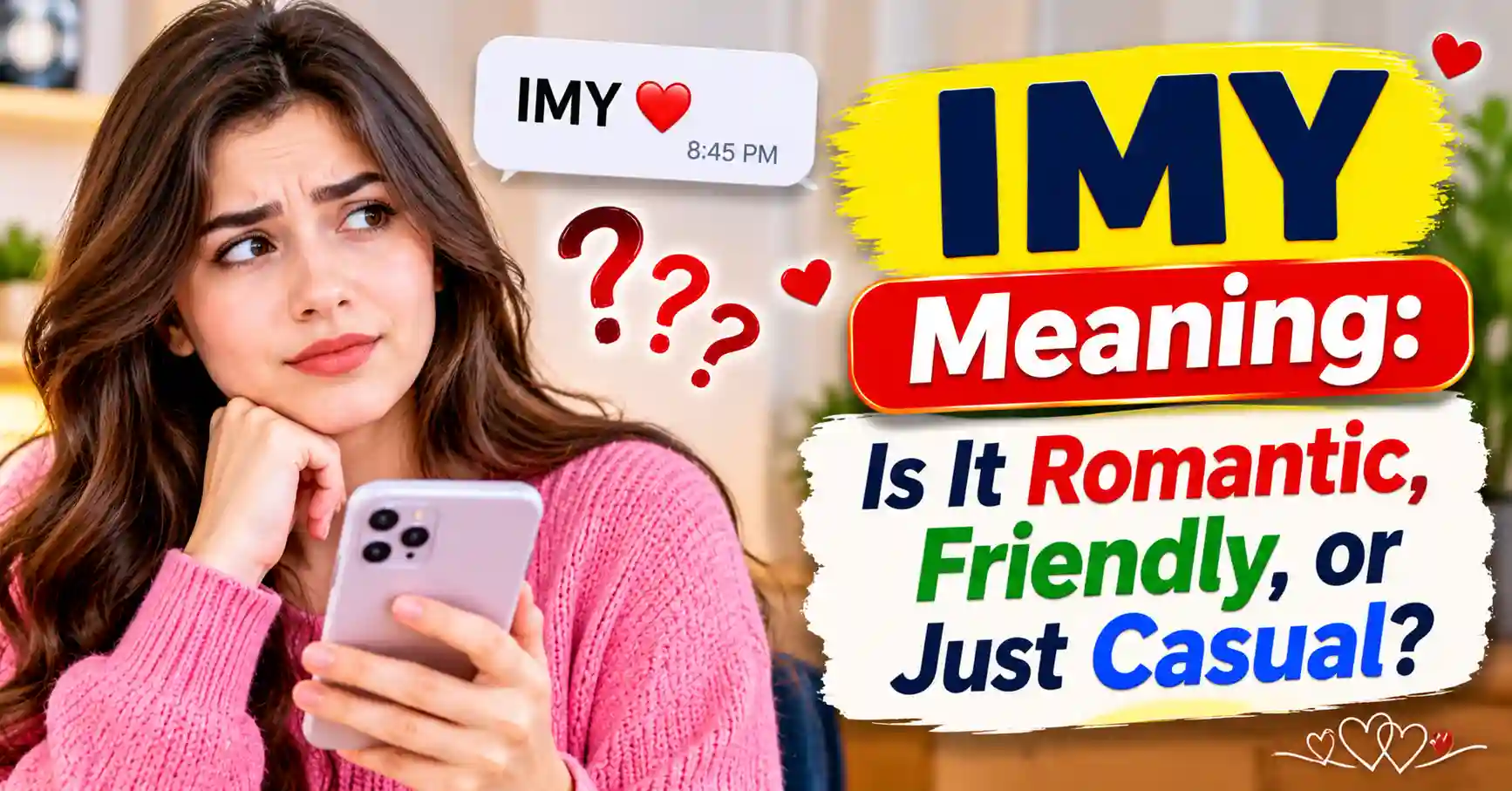
A message pops up from someone you have texted twice this month: “imy.” No emoji. No context. Just three letters. Your first thought is simple. Do they like me, or is this just a friendly hello?
That small question causes a lot of overthinking. The shortcut sounds warm, and warmth can mean many things. A close friend can send it. A partner can send it. A cousin you rarely see can send it. An ex can send it too, and that one feels very different.
This guide explains the imy meaning in plain words, then does what most guides skip. It shows you how to tell romantic, friendly, and casual versions apart. You will learn what clues to check, how to reply, and when to send it yourself. You will also find specific examples, common mistakes, and a side-by-side comparison with ILY, IMU, and other short messages. Each section uses short sentences, so you can skim and still find your answer.
Quick answer: IMY stands for “I miss you.” It can sound romantic, friendly, or casual. The sender, the timing, and the extra words decide which one it is.
Read More: NVM Meaning at the End of a Text: Examples & Correct Usage
What Is IMY? A Simple Explanation
What does IMY stand for? It stands for “I miss you.” Each letter matches one word: I, Miss, You. People type it in texts, direct messages, and social media comments.
Some people search with spaces between the letters. If you typed i m y meaning into a search bar, you found the right place. The spaced version and the joined version mean the same thing.
The phrase “I miss you” expresses a feeling of absence. The sender notices that you are not around, and they want you to know it. That is all the abbreviation says. It does not say “I like you.” It says that your absence matters to them.
Why do people shorten it? Speed is one reason. Texting rewards short messages, and three letters are easy to send. Another reason is comfort. Some people find it easier to type a short code than to say a full, emotional sentence. The shortcut feels lighter. It lets the sender share a feeling without making a big moment out of it.
Dictionary-style sources, including Wiktionary, list it as internet slang and text shorthand for “I miss you.” They point to ILY, which means “I love you,” as a related term. There is no hidden second meaning in normal texting.
You will see it in several forms. “imy” in lowercase looks casual. “IMY” in capitals looks louder and a bit more intense. Some people add emoji. Others add extra letters, such as IMYSM for “I miss you so much.” The core message stays the same. Only the strength changes.
The key point: the words are simple, but the feeling behind them depends on who sends them. That is why one three-letter message can leave you confused.
Is IMY Romantic, Friendly, or Casual?
The honest answer is that it can be all three. The abbreviation itself is neutral. The relationship between the two people decides the flavor. Here is how each version looks.
The romantic version. A partner, a crush, or someone you date sends it. The message often comes with a warm emoji, a pet name, or a plan to meet. “I’m ❤️ can’t wait to see you” is a clear example. In this case, the sender wants you to know they long for your company.
The friendly version. A close friend or family member sends it. They miss your presence but feel no romantic interest. “I miss you!! We need to hang out soon” is a typical line. It sounds affectionate and bright. It often comes with a plan to catch up.
The casual version. An acquaintance, a former classmate, or a coworker sends it. They might use it as a light, easy greeting. “I’m, how have you been?” asks about you with no deeper meaning. In this case, the message is polite and short.
The emotional version. Sometimes people send it when they feel lonely, sad, or nostalgic. It can follow a move, a breakup, or a long gap. This version feels heavy. It may need a gentle, honest reply.
How do you tell them apart? Use three quick questions.
- Who sent it? A partner points to romance. A friend points to friendship.
- What came before it? A warm chat points to affection. A long silence points to nostalgia.
- What came with it? A plan, a compliment, or a question reveals the intent.
When the answer is still unclear, do not guess. The imy meaning in your chat depends on the person, not just the letters. A short, kind question solves it: “Aw, I miss you too. What made you think of me?”
Explore More Meaning: IEP Meaning in Special Education: Definition, Examples & Usage
Reading the Tone: Clues That Reveal the Intent
Text has no voice, no face, and no body language. That is why you must read the clues. Seven signs help.
The sender’s history. Think about how this person usually talks to you. If they send warm messages to everyone, IMY likely follows the same pattern. If they rarely message you, a sudden IMY stands out.
The time of day. A message at lunch feels casual. A message at midnight can feel more personal or lonely. It can also be a friend in a different time zone.
The emoji. Hearts and kisses lean romantic. Laughing faces lean friendly. A sad face leans emotional. No emoji leans neutral.
The punctuation. “imy.” sounds quiet or serious. “imy…” can sound wistful.
The extra letters. IMYSM and IMYMTA signal stronger feelings than plain IMY. The more letters, the more intensity.
The follow-up. A message that asks to meet shows interest in seeing you. A message that stops after three letters leaves the next move to you.
The context. Did you just move? Did you have a fight? These events change how the message feels.
Here is a quick example. Two friends spent the summer together. One returns home and sends “I’m already.” That is friendly and affectionate. Now picture a person who stopped talking to you for months and then sends “imy” at 1 a.m. That message carries more emotion, and it may need a careful answer.
Remember that tone is not a promise. Someone who sends IMY does not owe you romance, and you do not owe them a reply in kind. Respect the feelings behind the words, but do not read more into them than the sender wrote.
The IMY meaning stays steady, but the mood changes with each clue. When the clues point in different directions, treat the message as warm but unclear.
Meaning Tips You May Like: ESL Meaning for Beginners: Simple Definition, Examples & Usage
IMY Variations and What They Add
People stretch the abbreviation in many ways. Each version changes the strength or the tone.
IMU. This also means “I miss you.” The “U” stands for “you,” just as in many other texting shortcuts. IMU and IMY are interchangeable.
IMYSM. This stands for “I miss you so much.” It adds intensity. Use it when the feeling is strong.
IMYM. This stands for “I miss you more.” People use it to reply when someone says they miss them. It adds a playful edge.
IMYT. This stands for “I miss you too.” It is a quick, friendly reply.
IMYMTA. This stands for “I miss you more than anything.” It is a very strong version, and people use it in close relationships.
IMYS. This stands for “I miss you so.” It is a lighter way to add emphasis.
MU. This stands for “miss you.” It drops the “I” and feels shorter and breezier.
Miss ya. This is a spoken-style version. It feels warm and informal.
Why do these variations matter? They help you match your feeling to your words. A plain IMY says, “I thought of you.” IMYSM says, “I really feel your absence.” Choosing the wrong version can send the wrong signal. If you want to keep things light, use IMY or MU. If you want to show deep feeling, use a longer phrase or write the full sentence.
A final tip: when feelings run deep, write the whole thing. “I miss you so much, and I hope we can talk soon” carries more warmth than any code. Abbreviations are handy, but they can feel thin when the moment calls for care.
How to Reply to IMY
Your reply should match your real feelings. Here are options for common situations.
You miss them too. “I miss you too! 🥰” or “I miss you too. When can we talk?” Keep it warm and honest. Add a plan if you can.
You feel friendly but not romantic. “Aw, I miss you too! Let’s catch up soon.” This keeps things kind and clear. It signals friendship without hurting the sender.
You are not sure how you feel. “That is sweet. How have you been?” This answers with care and moves the chat forward without promising more.
You do not feel the same. Be gentle but clear. “Thank you for telling me. I am glad we are friends.” Avoid sending mixed messages. Honesty protects both people.
It came from an ex. Pause before you answer. Ask yourself what you want. You can reply kindly without reopening the past: “I hope you are doing well.” If the message feels hard to handle, take time before you respond.
It came from someone you do not know. Be careful. Do not share personal details, your location, or photos.
You do not want to reply. You are allowed to stay quiet.
A few general rules help, whatever the implied meaning is for the sender. Reply in the same tone you feel. Do not copy the abbreviation if it does not match your feeling. Add a few extra words so the other person knows where they stand. And if the topic feels heavy, move the chat to a call or an in-person talk.
If you are replying to someone who is sad or lonely, offer support. “I am here for you. Want to talk?” can mean more than any abbreviation.
Keep Exploring: IEP Meaning in Special Education: Definition, Examples & Usage
When to Send IMY (and How to Make It Clear)
Sending IMY feels easy, but a few habits help you avoid confusion.
Know your intent. Ask yourself why you want to send it. Do you want to plan a meeting? Do you hope for a romantic reply? Knowing the goal helps you choose the right words.
Add context. “imy, want to grab lunch this week?” gives the reader a clear next step. A lone “imy” leaves them guessing.
Match the relationship. Between close friends or partners, IMY fits well. With a new acquaintance, it may feel too strong. With a coworker, it can feel out of place.
Be honest about romance. If you feel romantic interest, a vague IMY may not say enough. A clear sentence works better: “I miss you, and I would love to see you.” Respect the other person’s answer.
Respect boundaries. If someone has asked for space, do not send repeated IMY messages. Give them time. A pattern of unwanted messages can feel like pressure.
Pick the right moment. After a trip, a move, or a long gap, IMY lands well. In the middle of an argument, it can feel like a way to dodge the issue.
Anyone who types i m y meaning into a search bar learns it stands for “I miss you.” If you doubt your reader will know, spell it out the first time. Older relatives and new English learners may not recognize it.
For formal settings, skip it. Messages to a manager, teacher, or client call for full sentences. A line such as “It was great to see you last week” sounds warm and professional.
Finally, think about how it will feel on the other end. A short message can warm someone’s day. A confusing one can keep them up at night. A few extra words show care.
IMY in Different Relationships
The same three letters change flavor with each relationship. Here is how they usually feel.
With a romantic partner. IMY often feels loving and intimate. It may come with hearts, pet names, or plans to meet. In a long-distance relationship, it can be a daily comfort.
With a crush or a new date. It can signal rising interest. It can also feel like too much, too soon. If you send it early, add a light follow-up so the other person does not feel pressured.
With a close friend. It feels warm and affectionate. Friends use it after trips, moves, or long gaps. It often leads to a plan.
With a family member. Parents, siblings, and cousins use it as a quick “I am thinking of you.” It carries love without any romantic meaning.
With an ex. It feels loaded. It can signal nostalgia, regret, or hope. Think carefully before you reply. Clear boundaries help.
With an old classmate or acquaintance. It can be a friendly nudge to reconnect. It often means “let’s catch up” and nothing deeper.
With a coworker. It is rare and may feel too personal. In a friendly workplace, a close colleague may send it after a long leave, but most people stick to other phrases.
With an online friend. People who chat in games or on social media often use IMY to show friendship. It builds closeness across distance.
Why does the relationship matter so much? Because the same message can feel safe in one place and uncomfortable in another. A hug from a friend feels different from a hug from a stranger. Words work the same way.
If you feel unsure about a message from someone in a gray area, ask a clear, kind question. It saves both people from guessing.
Real-World Examples of IMY in Action
The scenes below are illustrative. They are made-up situations that show how people use the term. Each includes a quick note on the tone.
Example 1: The long-distance couple. “imy ❤️ counting down the days.” A partner shares longing and a plan. Tone: romantic.
Example 2: The college friend. “imy!! Come visit this weekend?” A friend asks for a meetup. Tone: friendly.
Example 3: The cousin. “imy, we haven’t talked in forever. How are you?” A relative reconnects. Tone: casual and warm.
Example 4: The late-night message. “imy” arrives at 1 a.m. from a person you have not heard from in months. The reader pauses and replies, “Is everything okay?” Tone: emotional and unclear.
Example 5: The fresh crush. After two dates, someone writes, “I’m already 😳.” The emoji adds shyness. Tone: romantic but nervous.
Example 6: The group chat. A friend moves away. The group sends, “I’m already 😭.” Everyone joins in. Tone: friendly and playful.
Example 7: The ex. “I miss you sometimes.” The reader feels torn and takes a day to reply. Tone: nostalgic and heavy.
Example 8: The parent. “imy, call me when you can.” A parent checks in. Tone: caring.
Example 9: The unknown account. A stranger sends “imy” on social media. The reader blocks the account and keeps personal details private. Tone: suspicious, handled safely.
Notice the pattern. The same message carries love, friendship, nostalgia, or even suspicion. Time, emoji, and relationship change the feeling. That is why the imy meaning needs context to make sense.
Common Mistakes and Misconceptions
A short phrase can still cause long confusion. Here are the most common mistakes.
Mistake 1: Assuming it is always romantic. Friends, family, and classmates use it too. Read the whole context.
Mistake 2: Assuming it is never romantic. Some senders do feel romantic interest. Look at the clues.
Mistake 3: Mixing it up with ILY. IMY says “I miss you.” ILY says “I love you.” The two are very different. Do not treat IMY as a love confession.
Mistake 4: Believing the odd definitions. Some pages claim IMY can mean “I’m yours” or “I like you.” Reliable dictionary-style sources list only “I miss you.” Treat the odd claims as overreading.
Mistake 5: Overthinking three letters. You do not need to decode every detail. A calm, honest reply works.
Mistake 6: Using it to avoid a real talk. If you have a serious feeling, say it in full words. A vague message can leave the other person confused.
Mistake 7: Sending it too often. Repeated IMY messages can feel like pressure, especially if the other person has not replied.
Mistake 8: Ignoring safety. A stranger’s IMY is not a friendly hello. Be careful with personal details.
Mistake 9: Using it in formal settings. It can look out of place in work or school messages.
Mistake 10: Treating a reply as a promise. An “IMY too” does not mean romance or a future plan. It means the person misses you.
Mistake 11: Forgetting the reader. Not everyone knows text slang. Spell it out for new readers.
The IMY meaning is simple, and these mistakes come from reading too much or too little into it.
IMY vs. ILY, IMU, and Other Short Messages
Many short messages sound alike but carry different weight. Here is how they compare.
IMY (I miss you). It expresses longing for someone’s presence. It can be romantic, friendly, or casual.
ILY (I love you). It is stronger and more committed than IMY. It can be romantic or family-based.
IMU (I miss you). It means the same as IMY. People use it as a variant. The “U” stands for “you,” as in many other texting shortcuts.
MU (miss you). It drops the “I” and feels lighter. It works well for a quick note.
“Miss ya.” It sounds friendly and warm. It suits a casual chat.
TOY (thinking of you). This means you crossed someone’s mind. It is softer than IMY because it does not say you feel the gap.
“Can’t wait to see you.” This looks forward. It focuses on the future, not on the absence.
“Hey, how are you?” This opens a chat. It does not express longing at all.
How do you pick? Use IMY when you feel the gap and want the other person to know. Use ILY only when you mean love.
The comparison shows that the IMY meaning sits in the middle: warmer than a casual hello, but softer than a declaration of love.
Other Possible Meanings of IMY
In nearly every chat, IMY means “I miss you.” Still, a few other ideas show up online.
Some pages claim it can stand for “I’m yours” or “I like you.” Reliable dictionary-style sources do not list those meanings. These claims usually come from guesses or from pages that copy each other. Treat them with caution.
IMY can also appear as part of a name, a username, or a brand. A person called Imy, for instance, may use the letters in their handle. In that case, the letters are not a message at all.
How do you tell the difference? Look at the setting. A text that says “imy” right after a trip points to “I miss you.” A profile name that includes the letters points to a name. If you cannot tell, ask the sender what they mean.
What does IMY stand for in an unclear message? The safest answer is “I miss you.” If the context does not fit, ask. A quick question keeps you from guessing.
For people searching i m y meaning with spaces, the result is the same. The spaced letters just reflect how people type the question into a search bar.
FAQ: Quick Answers About IMY
What does IMY mean in a text?
IMY means “I miss you.” People use it to tell someone they feel the gap in their company. It appears in texts, direct messages, and social media comments. The tone can be romantic, friendly, or casual, depending on the relationship and the clues around it.
Is IMY romantic?
Not always. A partner or a crush may send it with romantic feelings, but friends, family members, and old classmates use it too. Check who sent it, what came before it, and what emoji or words came with it. When unsure, ask a kind question.
What is the difference between IMY and ILY?
IMY means “I miss you,” and ILY means “I love you.” IMY expresses longing for someone’s presence. ILY states love. ILY is stronger and more committed. The IMY meaning is softer, so it works for friends, family, and partners alike.
How should I reply to IMY?
Match your real feelings. If you miss them too, say “imy too” or write a warm sentence. If you feel friendly but not romantic, say you miss them and suggest catching up.
Does IMY mean someone likes me?
Not necessarily. IMY shows that the sender misses your company. That can come from friendship, family love, or romantic interest. Look at the clues, such as emojis, timing, and past behavior. A calm question can clear up the intent. Never assume romance from three letters.
Is IMU the same as IMY?
Yes. Both mean “I miss you.” IMU uses “U” for “you,” which is common in texting. People use them interchangeably. Pick whichever feels natural. Neither one is stronger than the other. The tone depends on the sender and the context, not on which version they pick.
Can I use IMY with a coworker or teacher?
Usually no. IMY is warm and personal, so it can feel out of place in professional or school messages. Use a full sentence instead, such as “It was great to see you last week.” With close colleagues, it may be fine, but not everyone knows the term.
Conclusion
The imy meaning is simple: it stands for “I miss you.” It tells someone that their absence matters. It can sound romantic, friendly, or casual, and the sender’s relationship to you decides which one.
Read the clues. Check who sent it, when they sent it, and what came with it. Reply honestly and kindly. If you want to send it, add a few words so your intent stays clear.
When feelings run deep, write the full sentence. Three letters are handy, but a few more words can show care. Whether you send it or receive it, treat IMY as a small piece of warmth, and let the context tell you the rest.
