

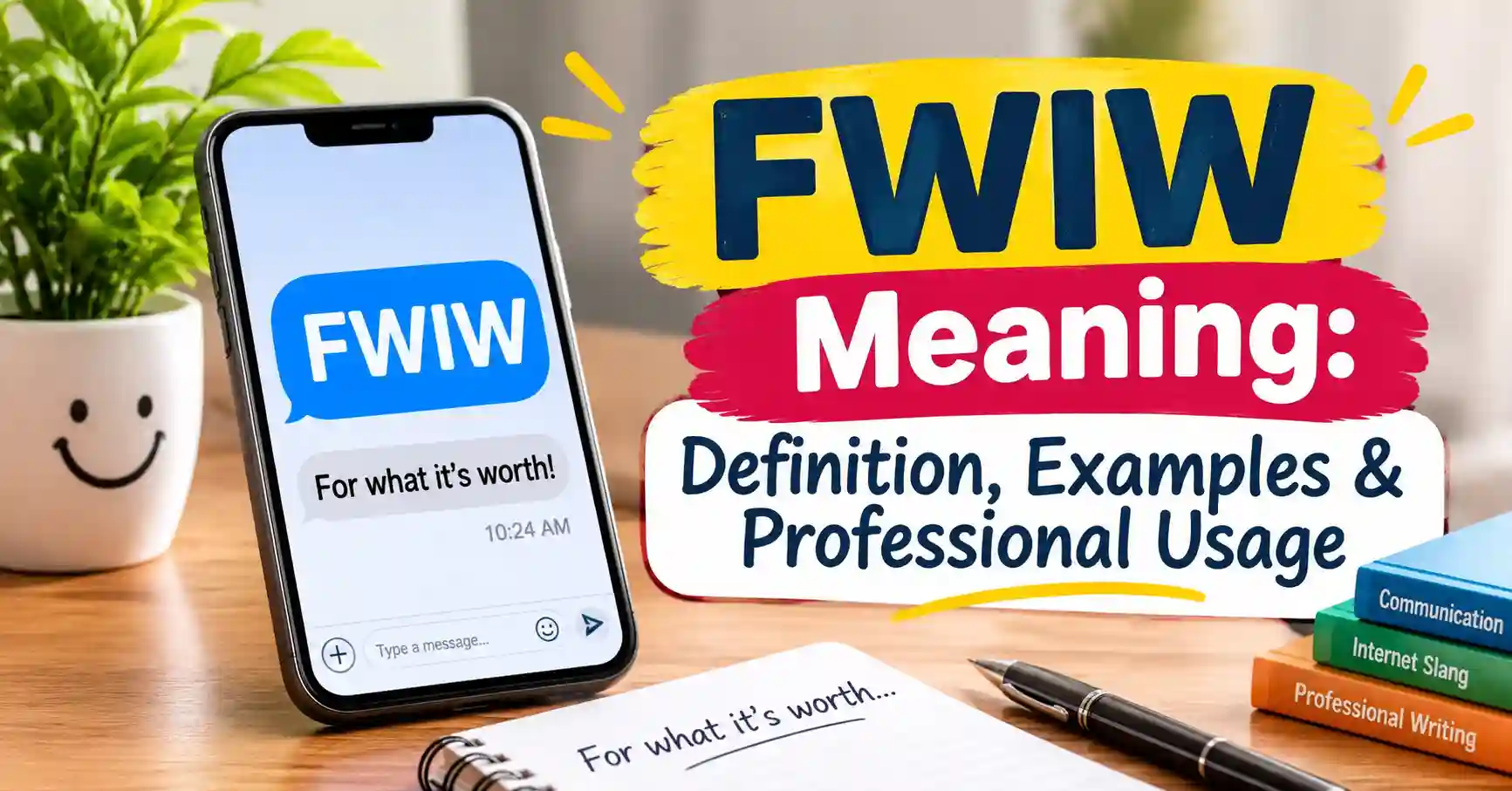
The Slack message lands at 4:52 p.m. It reads, “FWIW, I would have shipped it Friday.” You stare at it. Is your manager praising the plan? Criticizing it? Hinting that you missed something?
A few more words would settle it, but FWIW gives you almost none. That is the point of the abbreviation. It is also the problem. It softens a message so much that readers sometimes cannot tell what the sender really thinks.
This guide clears that up. You will learn the fwiw meaning in plain words, see where the phrase comes from, and learn how to read its tone. You will find out how to use it at work without sounding careless. By the end, you will know when to type FWIW and when to write the full thought instead.
Quick answer: FWIW stands for “for what it’s worth.” People use it to offer an opinion, a tip, or a fact without insisting that the other person must accept it.
Read More: Gyatt Meaning Explained: Where It Started and How It’s Used Now
What Is FWIW? The Full Explanation
What does FWIW stand for? It stands for “for what it’s worth.” Each letter comes from one word: For, What, It’s, Worth. Linguists call this kind of shortening an initialism, because people say the letters one by one. Most people never say “F-W-I-W” out loud, though. They type it, and they say the full phrase in speech.
The phrase works as an opener or a closer. A speaker adds it to a comment to signal one idea: “Here is my input. Take it or leave it.” The words “what it’s worth” admit that the value of the comment is unknown. The speaker does not claim to be right. They only offer it.
Why do people bother? Because direct statements can feel pushy. Compare these two lines:
- “You should book the early train.”
- “FWIW, the early train is usually less crowded.”
The first line gives an order. The second line shares an observation and lets the reader decide. That small change protects the relationship. It also keeps the conversation friendly when people disagree.
FWIW covers four common jobs:
- Opinions. “FWIW, I liked the second draft more.”
- Facts. “FWIW, the store closes at six on Sundays.”
- Advice. “FWIW, I would back up the file first.”
- Personal experience. “FWIW, it worked for me.”
In every case, the writer shares something and steps back. That mix of helpfulness and humility explains why the phrase has stuck around for so long.
Where FWIW Came From
The full phrase is much older than the abbreviation. People have said “for what it’s worth” in everyday speech for a long time. Many people also know it from the title of a 1966 song by Buffalo Springfield, written by Stephen Stills. The song title shows how common the phrase already was in spoken English.
The abbreviation grew with online writing. Email, chat rooms, and text messages all rewarded short replies. Early text messages had tight character limits. Typing four letters beat typing five words, especially on a phone keypad. People adopted FWIW the same way they adopted FYI and BTW.
The exact first online use is hard to pin down. Tech writers have noted that FWIW did not appear in some of the early jargon lists and did not dominate the early instant messengers. It spread later, as casual online writing became normal at work and at home.
Today, major dictionaries list FWIW as an abbreviation for “for what it’s worth.” That entry matters. It shows that the term has moved from a niche shortcut to a standard piece of English. The fwiw meaning is settled, even if its first appearance is not.
Why did it survive when other shortcuts faded? It fills a real gap. English has few quick ways to say, “I am sharing this, but I will not argue about it.” FWIW does that in four letters. As long as people want to speak politely and still speak up, the term has a job to do.
Explore More Meaning: HM Meaning: Thinking, Doubtful, or Annoyed? How to Tell
How to Use FWIW in a Sentence
Using FWIW is easy once you know the three common patterns.
At the start of a sentence. This is the most common spot. Follow it with a comma. “FWIW, the meeting starts at ten.” The comma separates the opener from the main point. Skipping it is common in chats, but it reads cleaner with one.
At the end of a sentence. Place it after your point, with a comma before it. “I would call the vendor first, FWIW.” This version feels lighter. It reads like a shrug, not a pitch.
On its own. A quick reply can be just the abbreviation plus a thought. “FWIW, same here.” Some people drop in a bare “FWIW” after a link or a screenshot. That works in casual chats where the context is obvious.
Capitalization is flexible. Most people write it in capitals. Lowercase “fwiw” looks more casual, and some readers hear it as more relaxed or sarcastic. Pick one style and keep it steady within a message.
What does FWIW stand for when you read it in a quick message? The full phrase, every time. If you are ever unsure whether a reader will know it, spell it out once. Then use the short form after that.
Grammatically, FWIW sits outside the main sentence. It acts like an introductory phrase. You can remove it, and the sentence still works. That tells you something useful: FWIW adds tone, not content. The point of your message must stand on its own without it.
Match the content to the phrase, too. Use FWIW with things the reader can take or leave. Skip it when the information is essential. A deadline, a safety warning, or a legal fact should never wear a “take it or leave it” label.
Meaning Tips You May Like: HM Meaning: Thinking, Doubtful, or Annoyed? How to Tell
What FWIW Really Signals: Reading the Tone
The same four letters can carry very different feelings. Reading the tone takes a little practice. Look at the clues around the phrase.
Friendly and helpful. Most uses fall here. The writer wants to help and does not want to press. “FWIW, I found a cheaper flight on Tuesday.” A warm tone, a useful detail, and no pressure.
Humble. The writer shares a view while admitting the limits of their knowledge. “FWIW, I am not an expert, but I would try restarting it.” This version builds trust because it is honest.
Defensive. The writer expects pushback. “FWIW, I did check the numbers twice.” The phrase protects the writer from blame. It still sounds polite.
Dismissive or cold. Short, flat replies can sting. “FWIW, nobody asked for that feature.” The softness of the phrase fails, and the message lands as criticism with a bow on it.
Passive-aggressive. Sarcasm can hide inside the phrase. “FWIW, I did warn everyone.” The writer says the point is optional but clearly wants it noticed. Readers pick up on the gap between the polite wrapper and the sharp content.
How can you tell which one you face? Check three things. First, check the content. Helpful details point to a friendly tone. Blame points to a sharp one. Second, check the history. A colleague who often supports you likely means well. Third, check the punctuation. Extra dots, a lone “fwiw,” or a flat period can signal irritation.
The fwiw meaning never changes, but the feeling does. When the feeling is unclear, ask. A short follow-up like “Do you want me to change it?” clears the air.
Keep Exploring: SC Meaning: Definition, Origin & How to Use It Correctly
FWIW in Professional Settings
The workplace is where FWIW gets tricky. It can make you sound considerate or evasive. The difference comes from how you use it.
Where it works. In chat tools and quick internal emails, FWIW helps you offer a suggestion without stepping on anyone. A teammate who wrote the plan may not welcome a harsh critique. A phrase like “FWIW, I would test this on a small group first” invites a discussion instead of a fight. Senior staff can use it to lower the pressure on junior staff. A manager who says “FWIW, this is how I handled it” shares experience without issuing an order.
Where it backfires. In formal documents, client contracts, reports, and legal or safety notices, FWIW sounds too casual. It also weakens the message. If a report says “FWIW, the audit found three errors,” readers may wonder whether the errors matter. Serious facts need confident wording.
Stronger alternatives. Try these when you want to sound polished.
- “One thing to consider is…”
- “My experience has been…”
- “Another option is…”
- “Based on what I have seen…”
A simple test helps. Ask yourself whether the reader needs the information. If yes, drop FWIW and state it clearly. If the information is a bonus, FWIW is a fine, friendly wrapper.
Knowing the fwiw meaning is easy. Knowing when it fits takes judgment. These quick rules help.
- Use it for optional points only.
- Put the useful detail right after it.
- Keep your tone warm, and avoid blame.
- Spell it out for readers who may not know it.
- Drop it when the message is urgent.
- Read the message once before sending. If it sounds like a shrug, choose clearer words.
Real-World Examples of FWIW in Action
The scenes below are illustrative. They are made-up situations that show how people typically use the term. Each one includes a quick note on why it works or fails.
Example 1: The group chat. Friend A writes, “I think the new cafe is overpriced.” Friend B replies, “FWIW, their brunch menu is half the price of dinner.” The reply adds a helpful fact. It does not argue with the opinion. Tone: friendly.
Example 2: The team channel. A designer posts a mockup. A colleague writes, “FWIW, the blue button might blend into the header.” The comment points out a risk without sounding harsh. The designer can ask follow-up questions. Tone: constructive.
Example 3: The client email. A project manager writes, “FWIW, we usually see better response when the email goes out on Tuesday morning.” The sentence shares experience and leaves the decision to the client. Tone: professional and polite.
Example 4: The code review. A developer comments, “FWIW, this loop could be a single query.” The note signals a suggestion, not a demand. The author can accept or explain why not. Tone: collaborative.
Example 5: The forum answer. Someone asks how to fix a slow laptop. A reply says, “FWIW, clearing the startup programs made a big difference for me.” The writer shares personal experience and avoids claiming it is the only fix. Tone: helpful and humble.
Example 6: The family text. A parent writes, “FWIW, the airport said traffic is heavy today.” This is a gentle nudge to leave early. The parent does not say it outright. Tone: caring.
Notice the pattern. The first eight examples add value without pressure. The last two misuse the phrase. The words stayed the same. Context and purpose changed the effect, which is why the fwiw meaning depends on the situation around it.
Common Mistakes and Misconceptions
A short phrase can still trip people up. Here are the mistakes that appear most often.
Mistake 1: Hiding important information. Wrapping a critical point in FWIW invites the reader to ignore it. If something matters, say it plainly.
Mistake 2: Using it as a passive-aggressive tool. Many people use FWIW to deliver a jab with a polite face. Readers usually spot it. The habit damages trust.
Mistake 3: Overusing it. Some writers add FWIW to every other sentence. Then it becomes filler, and the writer sounds unsure. Save it for moments when you really offer an optional extra.
Mistake 4: Misspelling the full phrase. The correct form is “for what it’s worth,” with an apostrophe in “it’s.” The version “for what its worth” is wrong because “its” is possessive. The apostrophe replaces the missing letter in “it is.”
Mistake 5: Mixing it up with a different idiom. “For all it’s worth” and “for all he was worth” are different expressions. The second often means “with cii flr wlpbk,” as in “he ran for all he was worth.” Neither one matches FWIW.
Mistake 6: Using it in formal writing. Academic papers, legal documents, and official letters call for full phrasing. If you need the idea, write “For reference” or “It is worth noting that.”
Mistake 7: Assuming it is rude. The fwiw meaning is not rude on its own. Tone depends on the content and the speaker. Treating every use as an insult causes needless tension.
Mistake 8: Believing the odd expansions. Some lists claim FWIW can stand for jokes like “For Whoever Is Watching.” Those appear only as rare, playful riffs. In almost every real message, it means “for what it’s worth.” Do not assume a hidden meaning without strong clues.
FWIW vs. FYI, IMO, and Other Shortcuts
Many abbreviations share ground with FWIW. They differ in purpose and strength. The fwiw meaning gets clearer when you see it next to the others. A side-by-side look helps you pick the right one.
FWIW (for what it’s worth). It offers something optional and keeps the tone gentle. It works for opinions, tips, and extra details.
FYI (for your information). It passes along information the reader should know. It is more direct than FWIW. In a work email, “FYI” says, “You need this.” “FWIW” says, “You might like this.” Use FYI for updates. Use FWIW for suggestions.
IMO and IMHO (in my opinion, in my humble opinion). These label a statement as your view. They are firmer than FWIW because they stake a claim. “IMO, we should cancel” takes a stand. “FWIW, we could cancel” offers an option.
AFAIK (as far as I know). It signals that your knowledge may be incomplete. Use it when you are unsure of the facts. FWIW instead signals that the point may not matter to the reader.
TBH (to be honest). It introduces a frank statement, often a blunt one. It raises the intensity. FWIW lowers it.
ICYMI (in case you missed it). It points back to something earlier. It does not offer a new view at all.
“Just saying.” It often follows a pointed remark. It can sound defensive or sharp. FWIW tends to sound milder.
A simple rule helps you choose. If the point is required, use FYI or write it directly. If the point is your view, use IMO.
FAQ: Quick Answers About FWIW
What does FWIW stand for?
FWIW stands for “for what it’s worth.” People use it to share an opinion, tip, or fact without insisting the other person must accept it. Dictionaries list it as a standard abbreviation. In speech, most people say the full phrase instead of reading the letters.
Is FWIW rude or passive-aggressive?
Not by itself. The fwiw meaning is neutral and polite. Tone depends on what follows it and who writes it. A helpful tip sounds kind. A jab with a polite wrapper can sound passive-aggressive. Read the context and the history between the people before you judge.
Is it okay to use FWIW in a work email?
Yes, in casual or internal messages with people you know. It works well for suggestions and extra details. Avoid it in formal reports, contracts, and messages to people who may not know the shorthand. Spell out the phrase or choose a clearer alternative.
What is the difference between FWIW and FYI?
FYI means “for your information” and shares facts the reader should know. FWIW means “for what it’s worth” and offers something optional. FYI feels firmer and more factual. FWIW feels softer and more personal. Pick FYI for updates and FWIW for gentle suggestions.
Where does FWIW go in a sentence?
Put it at the start with a comma, as in “FWIW, I would wait.” You can also place it at the end after a comma. It stands outside the main clause, so the sentence still works without it. Both positions are correct.
Should I write FWIW in capitals or lowercase?
Both are fine. Capitals are more common and look tidy. Lowercase feels casual and can read as relaxed or sarcastic. Choose a style that fits your audience. Consistency matters more than the choice itself. In professional writing, capitals or the full phrase look more careful.
Can I use FWIW in formal writing?
Usually no. Academic papers, legal documents, and official letters call for full wording. Replace it with phrases like “it is worth noting that” or “for reference.” Keep it for casual messages where a relaxed tone helps. If you quote someone’s message that includes FWIW, keep it as written.
Conclusion
The fwiw meaning is simple: “for what it’s worth.” It tells the reader that you offer a thought, a tip, or a fact, and that they can accept it or not. That small act of humility explains why the term has lasted.
Context decides how it lands. A friendly tip sounds kind. A sharp jab sounds cold. A critical fact buried under it sounds weak. Check your purpose before you type it.
Use FWIW for gentle extras and casual advice. Skip it for deadlines, safety, and serious findings. When a reader may not know the shorthand, write the whole phrase. Clear writing earns more trust than clever shortcuts. FWIW, that is the best advice here.
