

The phrase “wag meaning” is one of those search terms that looks simple but quickly becomes confusing once you explore it online. That’s because the word wag doesn’t have just one meaning—it changes depending on context, tone, and even capitalization.
For some people, “wag” refers to a dog happily moving its tail. For others, it shows up in discussions about cats and their emotional body language. And in completely different settings, especially sports media, WAG becomes a cultural acronym referring to the partners of famous athletes.
This mix of meanings is exactly why so many people search for wag meaning in the first place. They are trying to understand whether the word refers to behavior, slang, or something else entirely.
In this guide, we will break down every major meaning of “wag,” explore real-world usage, and explain how to interpret it correctly depending on context.
What Is WAG vs Wag?
At first glance, “WAG” and “wag” look like the same word in different formats. But they actually belong to completely different categories of meaning.
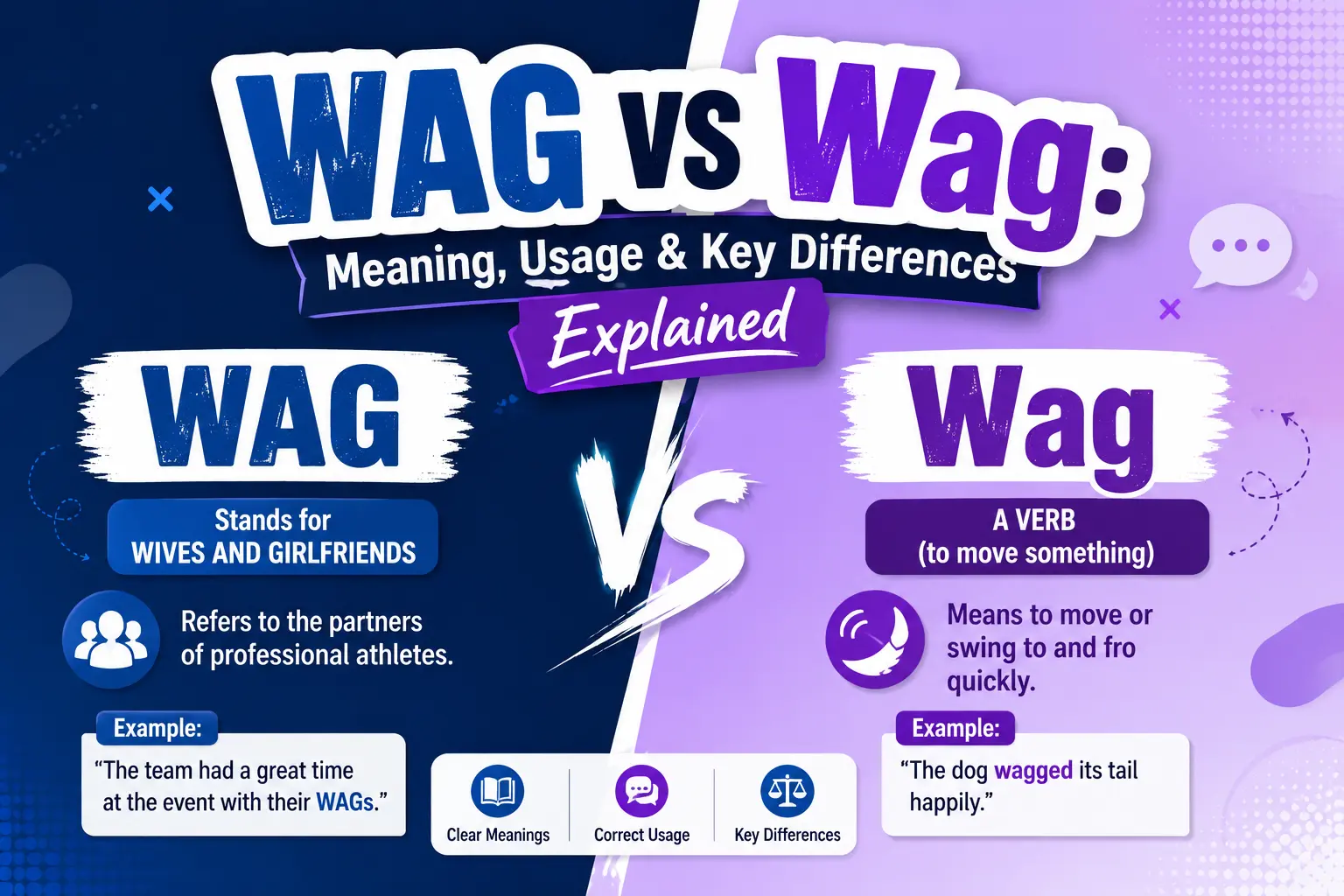
“WAG” (uppercase) is most commonly used as an acronym in British and global sports media. It stands for “Wives and Girlfriends,” referring to the partners of famous athletes, especially footballers. Over time, it became a cultural label used in tabloids, celebrity discussions, and entertainment reporting.
On the other hand, “wag” (lowercase) is a general English verb meaning to move something quickly from side to side or up and down. It is most commonly used when describing animals, especially dogs and cats, moving their tails.
Here’s where confusion begins: both versions appear in online searches about behavior and meaning, which leads people to mix them up. Someone trying to understand pet behavior might accidentally stumble into celebrity gossip definitions instead.
In many cases, users searching for what it means when cats wag their tails are not looking for slang or media acronyms at all—they’re trying to understand animal body language. Yet search engines often mix these meanings because the same word appears in multiple contexts.
So, while “WAG” is social and cultural, “wag” is physical and behavioral. One belongs to media language; the other belongs to movement and communication in both humans and animals.
Read more! 350+ Funniest Would You Rather Questions for Kids, Adults & Friends
Meaning of Wag in Everyday Language
The word “wag” in its simplest form is a verb describing motion. It typically means to move something repeatedly from side to side or back and forth.
In everyday English, you’ll hear it in phrases like:
- A dog wags its tail when excited
- Someone wags a finger to show disapproval
- A child wags their head to say “no”
This physical movement is usually fast, repetitive, and expressive. It’s a form of non-verbal communication.
In animal behavior studies, tail movement is particularly important. Cats and dogs use their tails to express emotion, intention, and alertness. However, unlike dogs, cats don’t always wag their tails to show happiness.
That’s where confusion starts. Many people assume tail wagging always equals joy, but in cats, it can signal irritation, focus, or overstimulation depending on speed and position.
This is exactly why people often search for what it means when cats wag their tails after observing unusual pet behavior. The answer isn’t always simple because feline communication is layered and context-dependent.
Understanding this basic meaning of “wag” helps separate physical movement from cultural slang, which is essential when interpreting both animal behavior and human language.
What Does WAG Mean in Culture and Media?
Outside of animal behavior, WAG has a very different identity.
In sports culture, especially football, “WAG” refers to “Wives and Girlfriends” of professional athletes. The term became widely popular in British media during the early 2000s, particularly during international football tournaments.
WAGs were often portrayed in tabloids as glamorous figures attending matches, living luxurious lifestyles, and appearing in media coverage alongside famous athletes.
Over time, the term evolved into a broader cultural label rather than just a literal description. It became associated with:
- Celebrity lifestyle reporting
- Fashion and luxury culture
- Media attention around athletes’ relationships
- Public fascination with the personal lives of sports stars
However, the term has also faced criticism. Many argue it reduces individuals to their relationship status rather than recognizing their personal careers or identities.
This is completely unrelated to animal behavior, yet many people searching for the general “wag meaning” accidentally land on this definition instead of the one they need.
That’s why understanding context is so important when interpreting language like what does it mean when cats wag their tail versus WAG in celebrity culture.
Cat Tail Language and Behavioral Signals
Cats don’t use words, but they communicate constantly through body language—especially their tails.
A cat’s tail can indicate multiple emotional states depending on movement and posture:
- A slow, gentle wag may show curiosity
- A fast flicking tail often signals irritation or overstimulation
- A puffed-up tail usually indicates fear or defensive behavior
- A relaxed upright tail often means confidence or comfort
Unlike dogs, cats do not consistently wag their tails as a sign of happiness. This difference is crucial.
When people ask what it means when cats wag their tails, they are usually trying to interpret subtle emotional cues. The truth is that feline tail movement is more complex than simple “happy” or “sad” categories.
For example, a cat sitting calmly while flicking its tail tip may be focused or slightly annoyed—not necessarily angry, but not relaxed either. Meanwhile, a full-body tail swish could indicate agitation or overstimulation.
Understanding these signals helps prevent miscommunication between humans and pets. Many behavioral misunderstandings come from assuming that animal expressions match human ones, which is not always the case.
This is also why the phrase what does it mean when cats wag their tail often appears in pet behavior searches—it reflects a genuine need to decode subtle communication patterns.
Why Wag Has Multiple Meanings Online
Language evolves differently on the internet compared to traditional dictionaries.
The word “wag” is a perfect example of this shift because it carries multiple meanings depending on context:
- Physical movement (animals, gestures, actions)
- Cultural acronym (WAG in sports media)
- Slang interpretation in casual conversation
- Search-driven phrases related to pets and behavior
Because of this overlap, search engines often display mixed results when someone types simple queries like “wag meaning.”
This is especially true for pet-related searches. A user might be trying to understand animal behavior but gets results related to celebrity culture instead.
That’s why contextual clarity matters. When someone uses the phrase what does it mean when cats wag their tail, they are clearly referring to biological or behavioral interpretation, not media slang or acronyms.
The internet doesn’t naturally separate these meanings unless the query is very specific, which is why confusion is so common.
Understanding this helps users filter irrelevant meanings and focus on the correct interpretation based on context.
Real-World Examples of Wag vs WAG Usage
To make things clearer, here are real-world examples showing how the word changes meaning depending on usage.
Example 1: Pet Behavior
A cat sits near a window, tail twitching slightly while watching birds outside.
An owner might wonder what it means when cats wag their tail in this situation, trying to determine if the cat is excited, focused, or mildly irritated.
Example 2: Sports Media
A newspaper headline reads: “Famous WAG spotted at football final wearing designer outfit.”
Here, WAG refers to the partner of a football player, not animal movement.
Example 3: Everyday Conversation
A parent says, “Don’t wag your finger at me.”
This is a gesture of disapproval, unrelated to animals or celebrity culture.
Example 4: Confused Online Search
Someone types “wag meaning” after seeing a cat move its tail quickly. Instead of finding behavioral explanations, they are shown sports articles about WAGs.
This mismatch is why clarity matters so much when interpreting the term.
Common Mistakes and Misconceptions
One of the biggest mistakes people make is assuming that “wag” always means happiness or friendliness.
In reality, context changes everything.
Mistake 1: Assuming All Tail Wagging Means Happiness
Many people believe tail movement in cats always signals joy. This is incorrect. Cats often wag their tails when annoyed or overstimulated.
Mistake 2: Confusing WAG With Wag
Capitalization changes the meaning completely. WAG is cultural slang, while wag is a physical movement.
Mistake 3: Ignoring Behavioral Context
Without observing the full body posture of a cat, tail movement alone can be misleading.
This is why searches like what does it mean when cats wag their tail often require deeper explanation than a simple definition.
Mistake 4: Overgeneralizing Internet Slang
Online definitions often blend multiple meanings, creating confusion.
Understanding context is the only reliable way to interpret the word correctly.
Comparison: WAG vs Wag
Here’s a clear breakdown of the differences:
| Feature | WAG | wag |
| Type | Acronym | Verb/action |
| Context | Sports & celebrity culture | Movement & behavior |
| Meaning | Wives and Girlfriends | Side-to-side motion |
| Usage | Media, entertainment | Animals, gestures |
| Emotional link | Social identity | Physical expression |
Despite sharing similar spelling, these two terms function in completely different linguistic categories.
This is also why misunderstandings happen when people search for what it means when cats wag their tails—they may unknowingly mix behavioral language with slang interpretations.
FAQ
What does WAG mean in football culture?
WAG stands for “Wives and Girlfriends” of athletes, especially football players. It is commonly used in the media to describe partners of sports personalities, often in entertainment or lifestyle coverage.
What does wag mean in animal behavior?
“Wag” refers to a physical movement, usually a side-to-side motion of a tail or hand. In animals, it is a form of communication that can indicate excitement, irritation, or alertness depending on context.
What does it mean when cats wag their tail?
When a cat moves its tail, it does not always mean happiness. It can indicate focus, irritation, curiosity, or overstimulation. This is why interpreting feline body language requires observing the entire posture, not just the tail.
Is WAG offensive?
In some contexts, yes. Some people see it as reducing individuals to their relationship status rather than recognizing their personal identity or achievements.
Why do people get confused between WAG and wag?
They look and sound similar but have completely different meanings. One is slang for people connected to athletes, while the other describes physical movement.
What does a cat wagging its tail mean?
A cat wagging its tail can mean different things depending on speed and posture. It may indicate irritation, curiosity, or mental stimulation rather than happiness, which is a common misconception.
Why is wag used so often online?
Because it appears in both animal behavior discussions and slang contexts, it is a versatile but confusing word in search engines and social media.
Conclusion
The words “WAG” and “wag” may look similar, but they belong to entirely different worlds of meaning. One is tied to sports culture and media labeling, while the other describes physical movement and animal communication. Confusion often arises when people search for simple explanations like what it means when cats wag their tails, only to encounter unrelated slang or celebrity references.
Understanding context is the key to interpreting both correctly. Whether you’re reading about pet behavior or celebrity culture, the meaning of “wag” changes depending on how and where it is used. Once you recognize that difference, the confusion disappears, and the language becomes much easier to navigate.
Love Me More: 350+ Funny Would You Rather Questions for Adults – Laugh Guaranteed
