

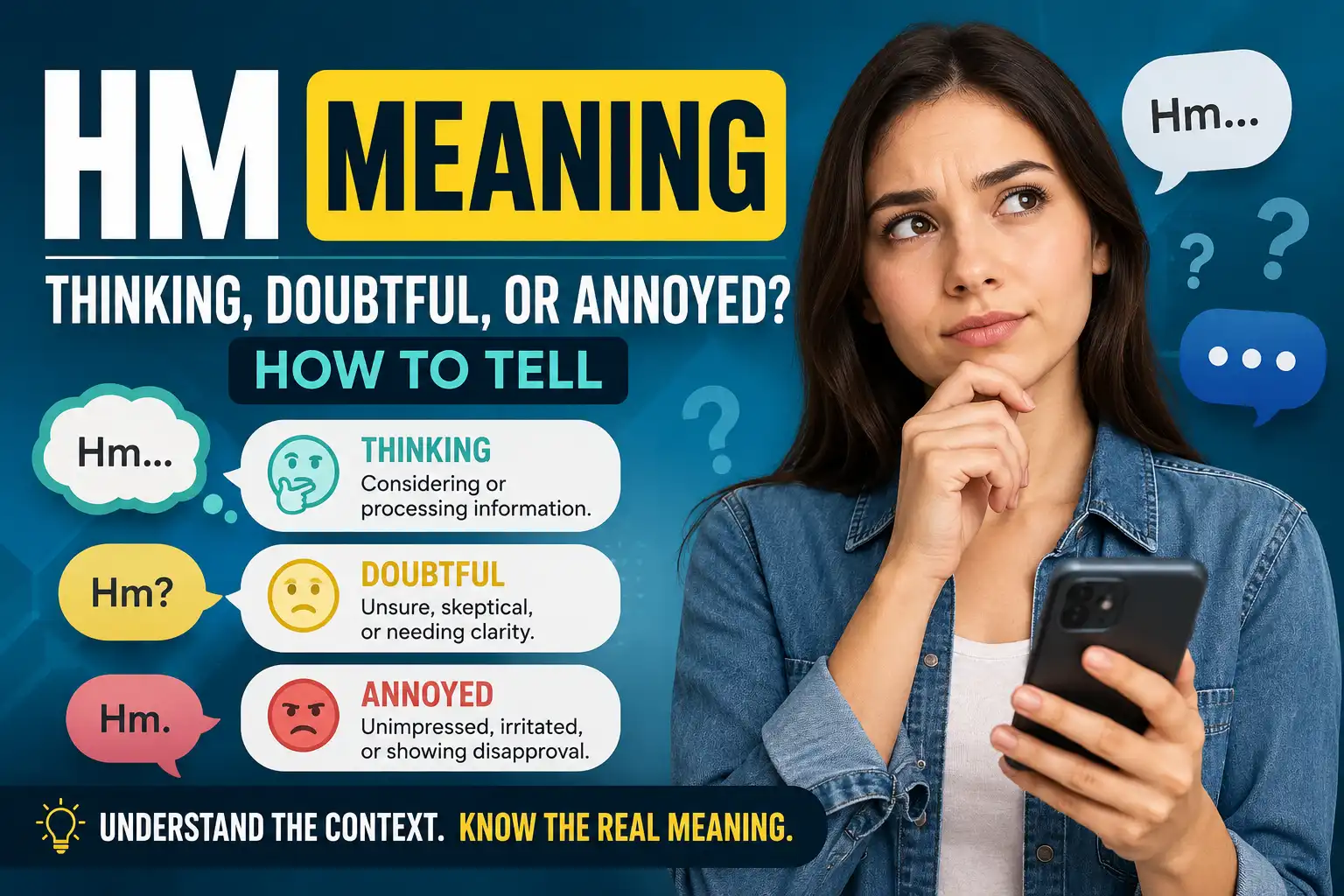
You send someone a message, wait for a reply, and finally see one short response: “hm meaning.” It looks simple, but that tiny word can create confusion. Is the person thinking? Are they unsure? Did they lose interest? Or are they quietly annoyed?
The truth is that hm’s meaning depends heavily on the situation, the relationship between two people, and the tone of the conversation. Unlike longer replies, this short expression leaves a lot of room for interpretation because it often represents a reaction rather than a complete answer.
People use “hm” in text messages, social media chats, comments, and everyday conversations to show that something has caught their attention. Sometimes it means they are considering an idea. Other times, it can signal hesitation, disagreement, curiosity, or even mild frustration.
Understanding this small expression can help you avoid unnecessary misunderstandings. A friend saying “hm” after hearing your plan may mean something completely different from a stranger replying with the same letters. This guide explains the different uses, emotional meanings, and examples so you can understand what someone really means when they type it.
What Is HM Meaning?
The word “hm” is a short conversational expression people use to show a reaction, thought process, or emotional response. It is not usually an abbreviation with a fixed definition. Instead, it works like a written version of a sound someone might make while speaking.
When people talk in person, they might say “hmm” while thinking, deciding, or reacting to information. In digital conversations, “hm” performs a similar role. It gives the other person a clue that the message has been received and is being processed.
The exact interpretation changes depending on the conversation. Someone replying “hm” after receiving advice may be considering what was said. A person responding during an argument may use it to show doubt or disagreement. In casual conversations, it may simply be a way to keep the conversation going without giving a detailed reply.
Many people search for what hm” means because they see it frequently in messages but cannot determine the emotion behind it. The answer is not always one specific meaning. The expression works more like a signal that tells you the person is reacting internally.
The number of letters can also change the feeling. “Hm” often feels shorter and more neutral, while “hmm” may sound more thoughtful. “Hmmm” can appear more dramatic, playful, suspicious, or deeply uncertain depending on the context.
Why People Use “Hm” in Text Conversations
1. HM as a Sign of Thinking or Processing Information
One of the most common reasons someone types “hm” is that they are thinking. It shows that the person has read your message and is taking a moment before responding.
For example:
Person A: “Should we try the new restaurant downtown tonight?”
Person B: “Hm, maybe. Let me check my schedule.”
Here, the response is not negative. The person is simply considering the suggestion before making a decision.
In face-to-face conversations, people naturally pause when they need time to organize their thoughts. Texting removes those visible pauses, so short expressions like this help recreate natural conversation patterns.
This usage is especially common when discussing:
- Plans
- Opinions
- Decisions
- Suggestions
- New information
Someone might write:
“HM, I never thought about it that way.”
In this case, they are showing that your point made them stop and think.
Understanding this context prevents people from assuming that a short reply is automatically negative. A brief message does not always mean a lack of interest. Sometimes the person is simply choosing their words carefully.
2. HM Showing Doubt, Uncertainty, or Hesitation
Another common use appears when someone is unsure about something. The expression can suggest that a person is not fully convinced or needs more information.
For example:
Person A: “I heard that this website gives free phones.”
Person B: “Hm…”
The reply may indicate suspicion. The person may not believe the claim or may want more details before accepting it.
This is where tone becomes important. A person who writes only “hm” without adding anything else may be expressing uncertainty. They might be silently questioning the information rather than agreeing.
Examples:
- “Hm, are you sure about that?”
- “Hm, I don’t know.”
- “Hm, that sounds strange.”
In these cases, the expression works as a soft way to show hesitation without directly saying, “I disagree.”
This is why many users ask what hm means in text, because the same two letters can represent different emotions. A person’s previous messages, personality, and relationship with you provide important clues.
If someone normally sends detailed messages but suddenly replies with “hm,” it may signal a different reaction than someone who always uses short responses.
3. HM as a Sign of Annoyance or Disapproval
Although “hm” is often neutral, it can sometimes carry a negative tone. The meaning changes when the conversation already includes tension, disagreement, or frustration.
For example:
Person A: “I forgot to complete the task again.”
Person B: “Hm.”
This response might suggest disappointment or annoyance. The person may not want to argue, but they are showing that they are not happy.
The same happens during disagreements:
Person A: “I think you misunderstood what happened.”
Person B: “Hm.”
Here, the short response may feel cold or dismissive. The person could be frustrated, unconvinced, or choosing not to continue the argument.
Signs that “hm” may have a negative meaning include:
- The conversation was already tense
- The person usually writes longer replies
- They stop asking questions
- Their replies become shorter
- They avoid continuing the topic
However, it is important not to assume someone is angry based on one message alone. Some people naturally communicate using very short responses.
How Context Changes the Meaning of HM
A single word can create different impressions depending on who sends it and why. The surrounding conversation usually matters more than the expression itself.
For example:
Friendly Conversation
Friend: “I finally bought the shoes I wanted.”
Reply: “Hm, nice.”
This could mean the person is interested but not overly excited.
Romantic Conversation
Person A: “I miss you.”
Reply: “Hm…”
This may feel uncertain, playful, shy, or emotionally complicated depending on the relationship.
Professional Conversation
Coworker: “I changed the project plan.”
Reply: “Hm, let’s discuss this.”
Here, it likely indicates careful consideration rather than emotion.
The platform can also influence interpretation. A message on Snapchat, TikTok, Instagram, or a private chat may have different expectations compared with an email or workplace messaging system.
When people search for what hm” means in texting, they often expect one universal answer. However, digital communication depends on tone, timing, and the relationship between the people involved.
A useful approach is to look at the entire conversation instead of focusing only on the short reply.
HM vs Hmm vs Hmmm: Are They Actually Different?
Although “hm,” “hmm,” and “hmmm” look almost identical, many people use them to express slightly different feelings. The number of extra letters can change the tone, especially in casual conversations.
The shortest version, “hm,” often feels more direct. It can show that someone is thinking, processing information, or giving a quick reaction. Because it is brief, some people may interpret it as colder or more serious compared with longer versions.
“Hmm” usually feels softer. It often suggests deeper thinking, curiosity, or uncertainty. For example:
Person A: “I think we should move the meeting to Friday.”
Person B: “Hmm, that might work.”
Here, the person is considering the idea instead of immediately accepting or rejecting it.
“Hmmm” can create an even stronger emotional effect. It may sound playful, suspicious, dramatic, or like someone is carefully analyzing something.
Example:
Person A: “I definitely didn’t eat the last slice of cake.”
Person B: “Hmmm…”
This could suggest that the person does not believe the statement.
The difference is not a strict grammar rule. People use these forms based on personal style, mood, and the situation. Some users type “hm” simply because they prefer shorter messages, while others choose “hmmm” to make their reaction more noticeable.
When understanding the meaning, it is better to focus on the entire conversation rather than counting letters. The same person may use different versions depending on their mood.
HM Meaning From a Girl: What Could It Suggest?
Many people search for the meaning behind a girl replying “hm” because they want to understand whether the message has a hidden emotional meaning. The reality is that there is no single answer. The interpretation depends on the conversation, relationship, and personality of the person sending it.
A girl may use “hm” when she is:
Thinking About Something
Example:
You: “Would you like to go out this weekend?”
Her: “Hm, let me see.”
This usually means she is considering the idea. It does not automatically mean rejection.
Feeling Unsure
Example:
You: “I think we should start a new project together.”
Her: “Hm, I’m not sure.”
Here, the response suggests hesitation. She may need more details before deciding.
Being Playful
Sometimes people use short sounds to create a teasing or mysterious tone.
Example:
You: “I have a surprise for you.”
Her: “Hm 👀”
In this situation, the reply may show curiosity rather than doubt.
Feeling Slightly Annoyed
Context matters. If there was a disagreement before the message, “hm” may sound less friendly.
Example:
You: “I forgot again, sorry.”
Her: “Hm.”
This could suggest disappointment.
The mistake many people make is assuming that a short reply always contains a hidden message about attraction, anger, or interest. A person’s normal texting style matters. Someone who regularly sends short answers may not be expressing anything negative.
The best way to understand the message is to consider previous conversations, timing, and whether the person continues engaging afterward.
HM Meaning From a Guy: Possible Interpretations
A guy using “hm” in a message can have several meanings depending on his communication style. Some people naturally use short reactions instead of full sentences, while others use them to express a specific feeling.
Common possibilities include:
He Is Thinking
A guy may send “hm” when he is processing information.
Example:
You: “Should we change our plans?”
Him: “Hm, maybe.”
This shows consideration rather than a clear yes or no.
He Is Curious
Sometimes the expression indicates interest.
Example:
You: “I have something interesting to tell you.”
Him: “Hm?”
The question mark changes the tone. It can mean “What happened?” or “Tell me more.”
He Does Not Know How to Respond
Some people use short expressions when they need time to create a better answer.
Example:
You: “I have been feeling stressed lately.”
Him: “Hm…”
This does not necessarily mean he does not care. He may simply be deciding what to say.
He Is Disagreeing Without Being Direct
In some situations, a person may avoid saying “I disagree” and use a short reaction instead.
Example:
You: “That movie was the best one ever.”
Him: “Hm, I don’t know.”
Here, the response shows a different opinion.
When analyzing what “hm ” means in texting, remember that digital messages remove voice tone and facial expressions. A short response can feel stronger than the sender intended.
How to Respond When Someone Sends “Hm”
Receiving “hm” can sometimes feel confusing because it does not provide much information. The best response depends on the situation.
If They Seem Interested
Continue the conversation naturally.
Example:
Them: “Hm, that sounds interesting.”
You: “Yeah, I thought you might like the idea. Want to hear more?”
This encourages them to share their thoughts.
If They Seem Unsure
Give them more information instead of pressuring them.
Example:
Them: “Hm, I’m not sure.”
You: “No problem. Take your time. I can explain more if you want.”
This keeps the conversation comfortable.
If They Seem Annoyed
Avoid immediately becoming defensive. Ask politely.
Example:
Them: “Hm.”
You: “Everything okay? Did something bother you?”
This gives them a chance to explain their feelings.
If You Are Unsure
A simple question is usually the best option.
Examples:
- “What are you thinking?”
- “Is that a good hm or a bad hm?”
- “What do you mean?”
These questions prevent unnecessary misunderstandings.
Text conversations often require interpretation because people cannot hear each other’s voices. A short expression can mean many things, so responding calmly works better than guessing.
Real-World Examples of HM in Different Conversations
Example 1: Making Plans
Alex: “Want to watch a movie tonight?”
Sam: “Hm, maybe after dinner.”
Meaning: Sam is considering the idea but is not ready to confirm.
Example 2: Sharing an Opinion
Alex: “I think this phone is better than the other one.”
Sam: “Hm, I still prefer the older model.”
Meaning: Sam is expressing a different opinion.
Example 3: Showing Curiosity
Alex: “You won’t believe what happened today.”
Sam: “Hm?”
Meaning: Sam wants more information.
Example 4: During a Disagreement
Alex: “I didn’t think my comment was rude.”
Sam: “Hm…”
Meaning: Sam may disagree or may be thinking about how to respond.
Example 5: Casual Friendship Chat
Alex: “I finally finished my assignment.”
Sam: “Hm nice.”
Meaning: A relaxed acknowledgment.
Common Mistakes and Misconceptions About HM
Mistake 1: Assuming HM Always Means Anger
A common misunderstanding is believing that “hm” is automatically negative. While it can sometimes show annoyance, many people use it simply as a thinking sound.
A friend may write it while deciding what to say or when they are interested in the topic.
Mistake 2: Reading Too Much Into One Word
People often analyze a short reply and create conclusions without looking at the bigger conversation.
For example, someone replying “hm” once does not necessarily mean they are upset, bored, or losing interest.
Look for patterns instead:
- Do they continue replying?
- Do they ask questions?
- Is their tone normally short?
- Did something happen before the message?
Mistake 3: Confusing HM With HMM
Although they are related, people may use them differently. “Hmm” often feels more thoughtful, while “hm” can feel quicker or more neutral.
However, personal texting habits are different for everyone.
Mistake 4: Believing There Is Only One Definition
The expression does not have one fixed meaning. Its interpretation changes based on:
- Relationship
- Situation
- Timing
- Previous messages
- Personality
This is why understanding the conversation is more important than memorizing a definition.
HM Compared With Other Common Texting Responses
Short replies are common in online conversations, but each one can create a different impression. Understanding the difference between similar expressions can help you read messages more accurately.
HM vs Hmm
The difference between “hm” and “hmm” is mostly about tone rather than definition.
“HM” often feels quicker and more direct. Someone may use it as a brief reaction when they are thinking, unsure, or acknowledging something.
Example:
You: “I might change my job next month.”
Friend: “Hm, interesting.”
The response suggests they are considering the information.
“Hmm” usually feels more extended and thoughtful.
Example:
You: “Should I buy this expensive laptop?”
Friend: “Hmm, I need to think about that.”
The extra letters can make the reply sound like the person is taking more time to decide.
However, there is no official rule that controls how many letters someone should use. Some people type “hm” for every situation, while others prefer “hmm.”
HM vs OK
“OK” usually shows agreement, acknowledgment, or acceptance. It tells the other person that the message has been received.
Example:
You: “I will call you at 8 PM.”
Reply: “OK.”
The meaning is generally clear.
“HM” does not usually confirm anything. It shows a reaction or thought process instead.
Example:
You: “I will call you at 8 PM.”
Reply: “Hm.”
This may suggest the person is thinking about the plan or has some hesitation.
HM vs LOL
“LOL” is used to show laughter or amusement. It creates a playful tone.
Example:
You: “I accidentally wore two different shoes today.”
Reply: “LOL.”
The reaction is obvious.
“HM” creates a completely different feeling. It suggests thought, uncertainty, curiosity, or a quiet reaction.
HM vs IDK
“IDK” means “I don’t know.” It directly communicates uncertainty.
Example:
You: “What time should we meet?”
Reply: “IDK.”
The person is saying they do not have the answer.
“HM” is less direct. It may show that someone is thinking before answering.
How Social Media Changed the Use of HM
Short expressions have become a normal part of online communication because people often want to reply quickly while still showing emotion. Words like “hm” help fill the gap between silence and a complete sentence.
On platforms such as Instagram, Snapchat, TikTok messages, and online forums, users often rely on short reactions to express their mood.
For example:
A comment saying:
“HM, that’s actually a good point.”
May show someone reconsidering their opinion.
A private message saying:
“Hm…”
may create curiosity because the reader wonders what the person is thinking.
Social media conversations also make tone more complicated because people from different age groups and backgrounds communicate differently. A teenager, a coworker, and a family member may use the same expression but intend different emotions.
This is why understanding what ” hm ” means requires looking beyond the letters. Online communication depends heavily on context.
Emojis, punctuation, and timing also influence interpretation.
Compare:
- “hm”
- “hm?”
- “hm…”
- “hm 😂”
- “hmmm”
Each version can create a different feeling.
For example:
“hm?” may sound like a question or a request for explanation.
“hm…” may suggest deeper thinking or hesitation.
How to Know the Real Meaning Behind Someone’s HM Reply
When you receive a short response, avoid guessing immediately. Instead, examine several clues.
Look at the Previous Message
The topic often reveals the purpose.
Example:
You say:
“I’m thinking about moving to another city.”
Reply:
“HM.”
This is likely a thoughtful reaction because the topic requires consideration.
Consider Your Relationship
A close friend using “hm” may communicate differently from someone you barely know.
A close friend might use it casually.
A new contact might use it because they are unsure how to respond.
Check Their Normal Texting Style
Some people write:
- “k”
- “sure”
- “hm”
- “yeah”
as regular responses.
For them, short messages may not carry a negative meaning.
Other people usually send detailed replies. If they suddenly become brief, it may indicate a change in mood.
Pay Attention to What Happens Next
The following messages often reveal more than the original reply.
Example:
Them: “Hm.”
Later: “Actually, tell me more about that.”
The first response was probably curiosity.
Another example:
Them: “Hm.”
Then they stop replying.
The meaning may be different.
A single message rarely provides enough information.
FAQ About HM Meaning
1. What does HM mean in the text?
HM is a short expression used in messages to show a reaction, thought, hesitation, or curiosity. The exact meaning depends on the conversation. Someone may use it while thinking, showing uncertainty, or reacting to something they find interesting.
2. What does hm mean in texting from a girl?
A girl using “hm” may mean she is thinking, unsure, curious, or simply responding casually. It does not automatically indicate anger, boredom, or romantic interest. The surrounding conversation and her usual communication style are better clues.
3. Is HM a negative response?
Not always. It can be neutral, positive, or negative depending on context. A person may use it because they need time to think, want more information, or feel uncertain. The topic and relationship between the two people determine the tone.
4. What is the difference between HM and HMM?
The difference is mainly the feeling behind the message. “HM meaning” often appears shorter and more direct, while “HMM” may sound more thoughtful or dramatic. However, people use both forms differently depending on personal texting habits.
5. Should I ask someone what they mean when they send HM?
If the response creates confusion, asking is completely fine. A simple message like “What are you thinking?” or “Is that a good hm or a bad hm?” can clear things up without creating tension.
6. Can HM mean someone is annoyed?
Yes, but only in certain situations. If the conversation involves disagreement or frustration, a short “hm” may show disappointment or annoyance. However, assuming anger from one word alone can lead to misunderstandings.
7. Why do people use short replies like HM?
People use short replies because texting does not include voice tone or facial expressions. Small expressions help communicate reactions quickly. They allow people to show that they are thinking, reacting, or processing information without writing a complete sentence.
Conclusion
A short message can sometimes create a bigger question than a long conversation. The phrase hm meaning is not limited to one definition because it changes depending on tone, situation, and the relationship between people. It can show thinking, uncertainty, curiosity, hesitation, or even mild frustration.
When someone types “hm,” avoid jumping to conclusions. Look at the full conversation, their usual texting style, and what happens afterward. Understanding what ” hm ” means in texting is less about memorizing a single answer and more about reading the context behind the message.
This small expression has become a common part of digital communication because it allows people to share reactions in a simple way. Once you understand the different uses, interpreting “hm” becomes much easier.
