

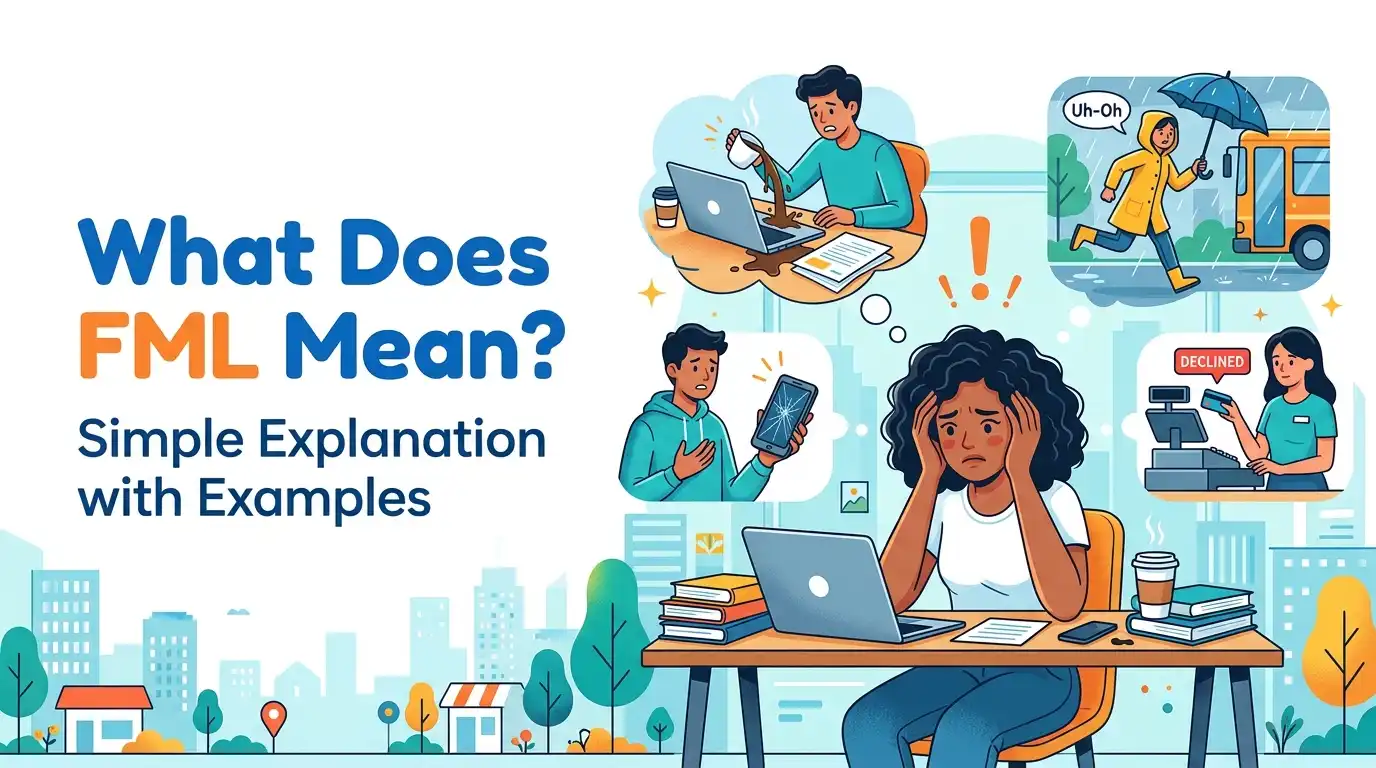
You dropped your phone screen-down on concrete, watched it crack. And your first reaction was to type three letters into a group chat: “FML.” Your friend replies with a laughing emoji instead of sympathy. And now you’re wondering if you used the phrase wrong or if there’s more to it than you thought. That confusion is exactly why so many people end up searching what does fml mean. After seeing it pop up in a text, a caption, or a comment section. It’s not a niche term or a typo — it’s one of the most common expressions of frustration used online today.
FML stands for “f*** my life,” an exclamation people use when something goes wrong. Whether that’s a minor annoyance or a genuinely rough day. It’s rarely meant to be taken literally. Nobody typing it is announcing a real crisis about their existence — they’re venting. Often with a bit of dark humor mixed in. This guide covers the full meaning, where the phrase came from. How it’s used across different platforms real conversation examples, common mistakes. People make with it and answers to the questions people ask most.
What Does FML Mean in Text?
The straightforward answer is that FML is short for “f*** my life.” It’s an expression of frustration, used the moment something goes wrong — big or small- and often typed out in the heat of the moment rather than after any real thought. Someone might text it after missing a bus, failing a test, spilling coffee on a white shirt, or dealing with something far more serious, like losing a job. The phrase flexes to fit almost any bad situation, which is a big part of why it’s stayed so popular for so long.
What makes this phrase interesting is the tone behind it. It’s rarely delivered as genuine despair. Most of the time, there’s a layer of self-aware humor in it — the person typing it knows the situation isn’t actually life-ending, and using an exaggerated phrase like “f*** my life” is part of the joke. It’s the digital equivalent of throwing your hands up and sighing dramatically rather than actually being in crisis.
Context changes everything with this phrase, though. If someone types it after stubbing their toe, everyone reading it understands it’s lighthearted. If someone types it after describing a genuinely difficult situation — a breakup, a family issue, a health scare — the same three letters carry real weight, and the people around them usually respond with actual concern instead of a joke back. Reading the surrounding message is the only reliable way to know which version you’re dealing with.
Where Did FML Come From?
The phrase “f*** my life” existed in spoken language long before it became an internet abbreviation — people have used variations of it as a frustrated exclamation for decades. What turned it into the specific three-letter acronym recognized today was a website launched in 2008 called FMyLife.com, where users submitted short, dramatic stories about bad moments in their day, each one ending with the tagline “What does FML mean in text?”
The site became massively popular almost overnight. People submitted stories ranging from mildly embarrassing to genuinely rough, and the format — a quick setup followed by the FML tag — turned into a recognizable meme structure that spread far beyond the website itself, eventually getting referenced in mainstream articles, TV segments, and even a short-lived TV pilot based on the concept. Within a year or two, people were using the abbreviation directly in texts, forum posts, and early social media captions without needing to reference the site at all.
Texting culture picked it up quickly because it fit the same pattern as other emotional shorthand like LOL, OMG, and WTF — a fast way to communicate a reaction without typing out a full sentence or needing to explain the backstory every time. Once it became common in text messages, it carried over naturally into Twitter, Instagram captions, and eventually TikTok comments, where short, punchy reactions perform especially well.
By the mid-2010s, the phrase had fully detached from its website origins in most people’s minds. Younger users who have never visited FMyLife.com still use the abbreviation constantly, simply because it’s been passed down through years of normal texting habits rather than because they know where it started. That’s a common pattern with internet slang — the origin fades, but the shorthand sticks around because it’s useful.
Why FML Stuck Around for So Long
Plenty of early internet acronyms faded out within a year or two, but this one has stayed relevant for well over a decade. A few reasons explain why people still reach for it instead of letting it die out like so many other trends.
It fills a specific emotional gap.
There isn’t really another short phrase that captures “something annoying just happened, and I need to vent about it” quite as efficiently. Saying “that’s frustrating” doesn’t carry the same dramatic, slightly funny punch, which is exactly the tone most people are going for.
It works on any scale of problem.
The same three letters apply whether you’re describing a stubbed toe or a genuinely bad week, which makes it more versatile than more specific slang tied to one type of situation.
It ages well because the underlying phrase never really goes out of style.
Unlike slang built around a specific meme, show, or trend that fades once the reference stops being relevant, “f*** my life” is built on a swear phrase people have used out loud for generations. The abbreviation just made it faster to type.
Repetition across platforms reinforced it.
Once it became common in texting, it carried over to captions, then comments, then video reactions, and each new platform exposed it to a slightly different audience who then carried it back into their own texting habits, keeping the cycle going.
Understanding what fml means today really means understanding this cycle — a phrase that started as spoken frustration, got formalized by a specific website, and then spread so widely through everyday texting that most people using it now have no idea it was ever tied to a single source.
How FML Is Used Across Different Platforms
The core meaning stays consistent everywhere, but the tone shifts slightly depending on where it shows up, and picking up on those small differences makes it much easier to tell whether someone’s genuinely upset or just being dramatic for effect.
In text messages
It’s usually sent between people who already know each other well, right after describing something frustrating that just happened. It often appears at the end of a message rather than the start, functioning almost like a punctuation mark on a complaint.
On Instagram
It shows up frequently in captions under photos documenting something that went wrong — a ruined outfit, a bad haircut, a travel mishap. The humor is usually front and center here, since captions are public and self-deprecating jokes tend to perform well.
On Twitter/X
The phrase gets used both seriously and jokingly, often attached to short vents about daily annoyances, work stress, or minor disasters. Because tweets are public and quickly scrolled past, people tend to lean into the dramatic, comedic version rather than genuine distress.
On TikTok
It frequently appears in comments reacting to relatable content — videos about awkward situations, workplace frustrations, or embarrassing moments often get flooded with people commenting just the acronym as a way of saying “this is so relatable it hurts.”
Recognizing the platform helps you judge intent. A caption on a blurry, chaotic vacation photo reads very differently from a private text sent right after describing a stressful conversation with a boss.
How to Use FML Correctly
Using the phrase well mostly comes down to matching it to genuinely frustrating (not devastating) situations, unless you’re intentionally leaning into dark humor with people who share that sense of humor.
Common ways it gets used:
- “Locked my keys in the car again. What does FML mean in text?
- “Forgot I had a presentation today and showed up in sweatpants, fml”
- “FML, my flight got cancelled, and I’m stuck at the airport overnight”
It also works as a standalone reaction to someone else’s story:
- Friend: “I just found out I have to redo this entire project from scratch”
- You: “fml, that’s brutal”
One important nuance — because the phrase includes profanity, tone and audience matter, and getting this wrong is one of the fastest ways to send the wrong signal to the wrong person. It’s generally fine in casual texts with friends, but it’s not something you’d type in a work Slack channel, a message to a teacher, or a formal email, even as a joke. Some people substitute “FML” specifically because it softens the visual impact of the full phrase compared to spelling it out, which is part of why the abbreviation became so much more common in everyday use than the full expression itself. Getting a feel for that line between playful venting and genuinely inappropriate timing is really the only skill involved in using this phrase well.
Real-World Examples of FML in Conversation
Seeing it across different real scenarios makes the range of the phrase clearer than any definition alone.
Example 1 — Minor daily annoyance:
“Spilled coffee all over my laptop right before a meeting, fml”
Example 2 — Group chat commiseration:
Person A: ” Just got a flat tire on the highway.” Person B: “fml that’s the worst, are you okay though?” Person A: “Yeah, just annoyed, gonna be late now”
Example 3 — Instagram caption under a chaotic travel photo:
“Missed our connecting flight by four minutes. fml.At least the airport pizza was good”
Example 4 — Dark humor between close friends:
“Failed my driving test for the third time. fml, I’m just gonna walk everywhere forever”
Example 5 — Genuinely rough situation:
“Found out today my grandma’s surgery got pushed back again. fml, just want some good news for once”
Example 6 — Work-related frustration (private text, not workplace chat):
“Boss just added three more things to my plate an hour before I was supposed to leave. fml”
Example 7 — TikTok comment on a relatable video:
“The way this is literally my exact morning routine going wrong every single day, fml”
Example 8 — Reconnecting after bad news:
Person A: “Hey, haven’t heard from you in a bit, everything okay?” Person B: “Not really tbh, car broke down, and now I’m dealing with insurance stuff. fml” Person A: “damn, that’s a lot. Let me know if you need anything”
Notice how the tone shifts across these examples — from lighthearted in the coffee and flight examples to genuinely heavier in the grandma’s surgery and car trouble examples. The phrase itself doesn’t change, but the emotional weight behind it depends entirely on what surrounds it.
Is FML Formal or Informal?
This one has a clear answer: it’s strictly informal, and that’s largely because of the profanity baked into the full phrase. You wouldn’t type it in a cover letter, a message to a client, or a note to a teacher, the same way you wouldn’t say the full phrase out loud in a job interview.
That said, plenty of otherwise professional people use it freely in personal group chats, private messages to close coworkers, or casual social media posts, because those spaces already allow relaxed language. The deciding factor isn’t really the person’s age or job — it’s whether the specific conversation already has room for casual, slightly crude language. If you’d swear out loud around that person without a second thought, texting the abbreviation is almost always fine too.
One extra consideration worth mentioning: because the phrase softens actual profanity into three letters, some people treat it as more acceptable in semi-public spaces like Instagram captions or TikTok comments than they would the fully spelled-out version. It’s still informal, but the abbreviation gives it just enough distance from the raw phrase to feel appropriate in more casual public settings.
Common Mistakes and Misconceptions
A handful of misunderstandings come up again and again with this phrase, so it’s worth addressing them directly rather than letting them cause unnecessary confusion or awkward moments in conversation.
Mistake 1: Assuming it always signals a real crisis.
Because the full phrase sounds dramatic, some people worry excessively when they see it, even when the surrounding message is clearly about something minor like spilled coffee or a missed alarm. Reading the full context prevents overreacting to a joke.
Mistake 2: Using it in professional or formal settings.
Even as a joke, sending it in a work email or a message to a teacher can come across as unprofessional given the profanity behind the abbreviation. Save it for casual, personal conversations.
Mistake 3: Ignoring genuine distress hidden behind casual language.
On the flip side, sometimes people use lighthearted phrasing to downplay something that’s actually bothering them a lot. If a friend types it after describing something that sounds genuinely stressful, it’s worth checking in rather than assuming it’s purely a joke.
Mistake 4: Confusing it with similar-looking acronyms.
FML sometimes gets mixed up with other three-letter texting slang at a glance, especially by people newer to texting abbreviations. Slowing down to actually read the full message avoids misreading the tone entirely.
Mistake 5: Overusing it until it loses meaning.
Some people attach the phrase to literally everything, from major setbacks to trivial inconveniences, which can make it harder for friends to gauge how seriously to take any individual use.
Mistake 6: Assuming it translates the same way across every age group.
Older relatives or coworkers less familiar with texting slang may not immediately recognize the abbreviation or may take it more literally than intended.
FML vs. Similar Texting Expressions
Frustration-related slang tends to cluster together, and several similar-looking acronyms get used in overlapping situations, which makes them easy to mix up if you’re newer to texting culture. Comparing this phrase to other frustration-related slang helps clarify exactly where it fits.
| Abbreviation | Full Phrase | Typical Tone | Common Use |
| FML | F*** my life | Frustrated, often exaggerated | Bad moments, from minor to major |
| SMH | Shaking my head | Disappointed, disapproving | Reacting to something frustrating or dumb |
| WTF | What the f*** | Shocked, confused, or annoyed | Surprising or upsetting situations |
| UGH | (not an acronym) | Mild frustration | Small annoyances |
| RIP | Rest in peace | Sympathetic, sometimes joking | Failed plans, embarrassing moments |
The clearest distinction is intensity and self-focus. WTF usually reacts to something external and surprising, SMH signals disapproval toward someone else’s actions, and RIP (used jokingly) mourns a plan or moment that didn’t work out. FML is more inward-facing — it’s specifically about something going wrong in the speaker’s own day or life, which is why it so often follows a personal complaint rather than a reaction to someone else’s situation.
Frequently Asked Questions
These are the questions people ask most often once the basic meaning clicks, covering everything from origin to appropriate use.
What does fml mean in text exactly?
It stands for “f*** my life,” an expression of frustration used when something goes wrong. It’s usually more exaggerated than literal, meant to vent about a bad moment rather than describe genuine despair.
What does fml stand for in full?
It stands for “f*** my life.” The abbreviation became popular through a website of the same concept in 2008 and later spread into everyday texting and social media use.
What does fml mean in text specifically?
In texting, it usually caps off a complaint or bad update, functioning like a dramatic sigh at the end of a message rather than a separate statement on its own.
Is FML always serious?
No, it’s usually lighthearted, especially for minor inconveniences like spilled drinks or missed alarms. It can carry real weight in heavier contexts, so reading the surrounding message matters.
Is it okay to use FML at work or school?
Generally, no, since it contains profanity. It’s fine in casual texts with friends but not appropriate for formal messages, emails, or professional chat channels.
Where did FML come from originally?
It traces back to FMyLife.com, a site launched in 2008 where users shared short, frustrating daily stories ending in “FML.” The phrase spread from there into everyday texting slang.
How should I respond if a friend texts me FML?
It depends on context. For something minor, a joke or lighthearted reply works fine. For something that sounds genuinely upsetting, a simple check-in like “you good?” shows you’re actually paying attention.
Conclusion
By now, the mystery behind those three letters should be fully solved. What does fml mean, in the simplest terms? It’s shorthand for “f*** my life,” a frustrated expression people reach for after something goes wrong, whether that’s a spilled coffee or a genuinely rough day. The tone almost always depends on context, and reading the message around it tells you whether someone’s joking or actually needs a bit of support.
Now that the full picture is clear — the meaning, the origin, and how it shifts across platforms — you’ll never have to pause and guess again the next time it shows up in your messages. And if you end up typing it yourself after a bad morning, you’re using it exactly the way millions of people already do, joining a habit that’s been part of everyday texting for well over a decade.
