

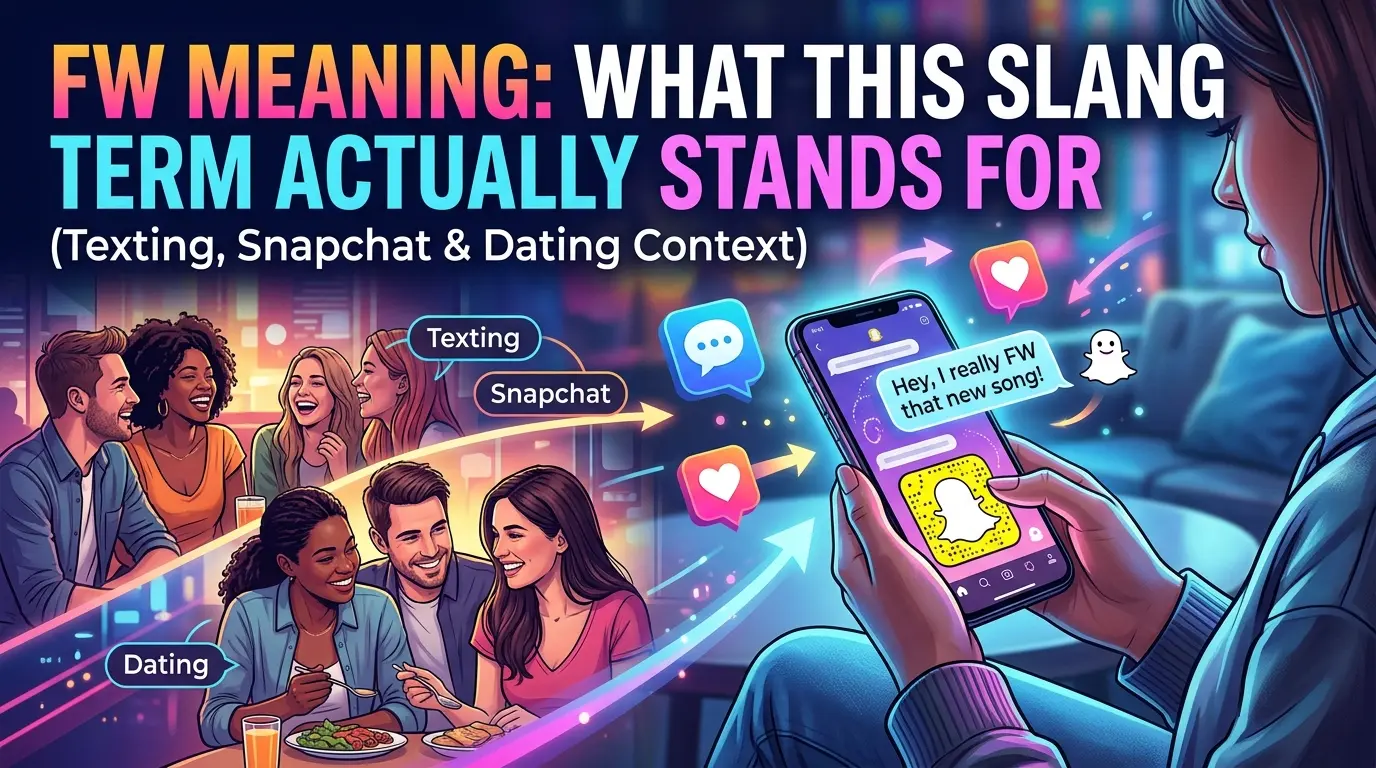
Here’s the short version before we go deep: the most common fw meaning is “f*** with,” used the way people say “I mess with you” or “I’m into you.” It’s casual, it’s affectionate, and it shows up constantly on Snapchat, iMessage, Instagram DMs, and group chats. But that’s not the only definition floating around, and context changes everything — which is exactly why this guide exists.
Someone sends you “fw you fr” after a first date, and you stare at your phone like it’s written in another language. Is it a typo? An abbreviation? A code word your friends forgot to warn you about? You’re not overthinking it — this is one of the most misread pieces of texting shorthand out there, and getting it wrong can genuinely change how you respond to someone you like.
Below, we’re breaking down every real-world use of this abbreviation, how it shifts between friendly banter and romantic interest, the mistakes people make when they misread it, and how it compares to similar slang you’ve probably also seen and wondered about.
What Does FW Mean?
At its core, FW is an abbreviation for “f*** with.” That phrase sounds aggressive out of context, but in modern texting slang, it rarely is. When someone says they “f*** with” a person, a show, a song, or an idea, they mean they like it, support it, or vibe with it. It’s approval — casual, low-effort, high-sincerity approval.
So when you’re trying to pin down the fw meaning in text, the safest interpretation is usually: I like this. I’m into this. I’m here for this. That’s it. No hidden agenda, no confusion required.
Here’s where it gets slightly more layered. FW can function as three different parts of speech depending on how it’s dropped into a sentence:
- As a verb phrase: “I fw that outfit” (I like that outfit)
- As a statement of approval on a person: “I fw her” (I’m into her, I respect her, or I’m attracted to her — context decides which)
- As a one-word reply: “fw it” or just “fw” as a reaction to something someone shared.
It also helps to think about what FW is not. It’s not a question, it’s not neutral, and it’s rarely used sarcastically — sarcasm around this phrase usually needs extra signals, like “lol” or a mocking emoji, to land correctly. Without those extra cues, people default to reading it at face value, which is exactly why the plain fw meaning — approval, plain and simple — holds up across almost every context you’ll run into. That consistency is actually part of the appeal. Slang that shifts meaning wildly depending on tone is exhausting to keep track of. This one doesn’t do that, which is a big reason it’s stuck around in everyday texting for as long as it has.
Where FW Comes From and Why It Spread So Fast
This abbreviation didn’t originate in texting — it started in spoken hip-hop and AAVE (African American Vernacular English) slang, where “f*** with” has been used for decades to describe loyalty, respect, or interest. Songs and interviews used the full phrase long before texting shortened it down to three letters. As slang from music and regional dialects moved onto Twitter, then Instagram captions, then Snapchat streaks, the phrase got compressed the way almost all high-frequency phrases do online — shorter typing, same meaning, faster delivery.
What accelerated the spread wasn’t just brevity. It was flexibility. A three-letter abbreviation that can express platonic approval, romantic interest, or general enthusiasm about literally anything is incredibly efficient. You don’t need five different words for five different kinds of “I like this” — you need one abbreviation that flexes with tone, and FW does exactly that. That’s a big part of why it never really faded out the way some slang trends do after a year or two.
FW Meaning on Snapchat
Snapchat has its own texture when it comes to slang, mostly because conversations there move fast, are visual, and often happen between people who already have some level of familiarity — friends, situationships, or people testing the waters before a first date. On Snapchat, FW shows up constantly as a reaction to a photo, a Bitmoji, a story post, or a Snap someone sent directly.
A typical exchange looks like this: someone posts a photo dump to their story, and a friend replies privately with “ngl I fw this pic.” Translation: I really like this photo. No romantic subtext required — this is standard friend-group communication, the digital equivalent of a compliment tossed across a room.
But Snapchat is also where the romantic version of FW gets a real workout, mostly because of how the app is structured. Private snaps, disappearing messages, and one-on-one streaks create an environment that already feels a little more intimate than a group chat or a public comment. So when someone sends “not gonna lie I kinda fw you,” inside that private, semi-vanishing environment, it reads differently than the same words would in a public comment section. It’s a quieter, lower-stakes way of admitting interest without fully committing to saying “I like you,” which is exactly why it works so well for people who aren’t ready to be direct yet.
Streaks also change how FW lands. If two people have kept a Snapchat streak going for months, a message like “I fw our streak lol” is somewhere between a joke and a soft admission that the ongoing contact matters to them. It’s low-stakes vulnerability wrapped in a joke, which is very on-brand for how Gen Z and younger millennials communicate feelings without fully exposing them.
FW Meaning in Dating Conversations
This is where the term carries the most emotional weight, and also where it causes the most confusion. In a dating context, FW usually signals genuine romantic or physical interest — but the intensity of that interest depends heavily on the rest of the sentence and the relationship stage.
Consider these three real-world variations, because the differences matter:
- “I fw you” — straightforward, casual interest. Not a declaration of love, but a genuine admission that this person is thinking about you in a romantic or flirtatious way.
- “I fw you heavy” or “I fw you hard” — this intensifies things considerably. Adding “heavy” or “hard” signals strong interest, sometimes bordering on emotional attachment, not just casual attraction.
- “I kinda fw you” — the hedge word “kinda” softens the whole statement. This is someone testing the water, admitting interest while leaving themselves an emotional exit if the feeling isn’t mutual.
Understanding this range matters because responding the wrong way can create real friction. If someone sends the hedged version and you respond as if they just declared serious feelings, it can feel like too much too fast. If someone sends the intensified version and you respond with a flat “thanks,” it can feel dismissive of something that took a small amount of courage to say.
There’s also a generational and regional layer worth mentioning. Younger daters, particularly those under 25, use FW far more casually than older millennials, who might reach for it only in more serious, established-interest contexts. If you’re unsure how someone means it, the safest move is to read the surrounding conversation tone rather than the abbreviation in isolation — three letters can’t tell you everything, but the sentence around them usually can.
FW Meaning in Everyday Texting (Beyond Romance)
Not every use of FW is about people. In fact, most day-to-day usage has nothing to do with dating at all. People use it constantly to express approval of music, shows, food, ideas, plans, and opinions.
Examples you’ll see in ordinary group chats:
- “I fw that new album so much” — genuine enthusiasm about music
- “ngl I fw this restaurant” — approval of a place
- “I fw that plan, let’s do it” — agreement with a suggestion
- “I fw your energy today” — a compliment about someone’s mood or attitude, still platonic
This everyday usage is honestly more common than the romantic version, which is part of why people get confused when they see it in a dating context for the first time. If your only reference point is friends using it about food or music, seeing “I fw you” from someone you’re texting can feel like a jump — but it’s really just the same approval mechanism, redirected at a person instead of a plate of tacos.
Real-World Examples Across Different Situations
To make this fully concrete, here’s how the term plays out across several realistic scenarios:
Scenario 1 — First date follow-up. After a first date, one person texts: “Had a really good time last night, ngl I fw you.” This is a soft, low-pressure way of saying the date went well and there’s romantic interest, without demanding an immediate declaration back.
Scenario 2 — Friend reacting to an Instagram post. Someone posts a new haircut, and a friend comments “I fw this new look fr.” Completely platonic, purely a compliment.
Scenario 3 — Group chat debating restaurants. Someone suggests a place for dinner, and another person replies, “I fw that idea, let’s go.” Here,e it functions almost like “I’m in” or “I agree.”
Scenario 4 — Situationship uncertainty. One person texts,s “I fw you, but I don’t know what we’re doing anymore.” This shows how the phrase can express genuine affection while still admitting confusion about the relationship’s direction — a very common modern dating dynamic.
Scenario 5 — Reacting to a Snapchat story. A private reply saying “ngl I kinda fw this energy” after someone posts a confident selfie. Flirty, but hedged enough to stay safe if it’s not reciprocated.
Each of these examples uses the identical three letters, yet the emotional temperature ranges from a passing compliment to a genuine confession of feelings. That range is exactly why context always outweighs the abbreviation itself.
Common Mistakes and Misconceptions
Mistake 1: Assuming FW always means romantic interest.
As shown above, most usage is completely platonic. Reading romance into every instance leads to awkward misunderstandings, especially in group chats.
Mistake 2: Confusing FW with “FWB.”
These are not related, despite looking similar. FWB stands for “friends with benefits,” describing a specific type of relationship arrangement. FW is a phrase of approval or interest. Mixing these up in conversation can send an entirely wrong signal — one is a feeling, the other is a relationship label.
Mistake 3: Treating it as aggressive because of the underlying words.
Because the full phrase technically contains profanity, some people assume it’s rude or confrontational when abbreviated. In practice, the abbreviated slang version has almost fully detached from that connotation. Nobody sending “I fw you” is being hostile.
Mistake 4: Ignoring intensity modifiers.
As covered earlier, words like “heavy,” “hard,” or “kinda” completely change the emotional weight of the phrase. Skimming past these modifiers is one of the most common ways people misjudge how serious someone actually is.
Mistake 5: Assuming it’s brand-new slang.
Because it trends periodically on TikTok and Twitter, some assume this is a recent invention. It’s actually been part of spoken slang for a long time — texting just compressed it.
FW vs. Similar Texting Slang
Since the FW meaning often gets grouped with other short slang terms, here’s a clear breakdown of how it compares:
FW vs. FWB: FW expresses liking or interest. FWB describes a defined relationship type (friends with benefits). One is an emotion, the other is a label for an arrangement.
FW vs. “I’m into you”: These mean almost the same thing. But FW is more casual, more common in early-stage texting, and lower-commitment in tone. “I’m into you” sounds more deliberate and serious by comparison.
FW vs. “vibing with”: Very similar in meaning and often interchangeable, though “vibing with” tends to skew slightly. More platonic and is used more for situations, moods, or general atmosphere rather than direct interest in a person.
FW vs. “rocking with”: Another close cousin, often used the same way — approval or support. Regional and generational preference usually decides which term someone reaches for.
Knowing these distinctions helps you avoid. The most common slip-up: pairing FW with FWB in your head simply because they share a letter pattern. They serve completely different conversational purposes.
Frequently Asked Questions
What does FW mean in a text message?
It typically stands for “f*** with,” used to express liking, approving of, or being interested in something or someone. It’s almost always positive, even though the full phrase sounds harsh out of context.
Does FW always mean someone likes you romantically?
No. Most everyday usage is platonic — approving of a photo, song, plan, or opinion. Romantic intent depends heavily on the rest of the message and the relationship context.
Is FW the same as FWB?
No. FWB stands for “friends with benefits,” a relationship arrangement. FW meaning is a general expression of approval or interest and isn’t a relationship label at all.
How do I know if someone means it romantically?
Look at the full sentence. Words like “heavy,” “hard,” or “fr” tend to intensify romantic meaning. While “kinda” or “ngl” often soften it into a low-pressure admission of interest.
Is it rude to say “I fw you”?
Not in modern texting culture. While the full phrase contains profanity. The abbreviated slang version has shed that harsh connotation and reads as casual, friendly approval.
Where did this slang term originate?
It comes from long-standing spoken slang. Particularly rooted in hip-hop and AAVE, where “f*** with” described loyalty, interest, or respect long before texting shortened it.
Can FW be used for things instead of people?
Yes, constantly. People use it to express approval of music, food, shows, plans, and ideas. Just as often — probably more often — than they use it about romantic interest in a person.
Conclusion
At the end of the day, the fw meaning boils down to one. Simple idea: approval, interest, or genuine liking, expressed in the fastest, most casual way texting culture allows. Whether it shows up as a compliment on a Snapchat story. A soft admission of feelings after a first date, or just agreement with a dinner plan in a group chat. The emotional core stays the same — someone is telling you they’re into something. Without making a big production out of saying so.
The real skill isn’t memorizing the definition. It’s reading the sentence around it. A hedge word like “kinda” and an intensifier like “heavy” can turn. The same three letters into two completely different messages. Once you start paying attention to that surrounding context. You’ll never second-guess a text like this again — and you’ll probably start using it a lot more naturally yourself. Whether you’re replying to a friend’s stor. Agreeing on where to grab dinner, or telling someone you’ve been talking to that you’re genuinely into them.
Love to read more WAG vs Wag: Meaning, Usage & Key Differences Explained
